
Guide
Does Vitalitown 120 Billion work? Thirty-six names, no strain codes, and 20 mg of enzymes
Quick answer
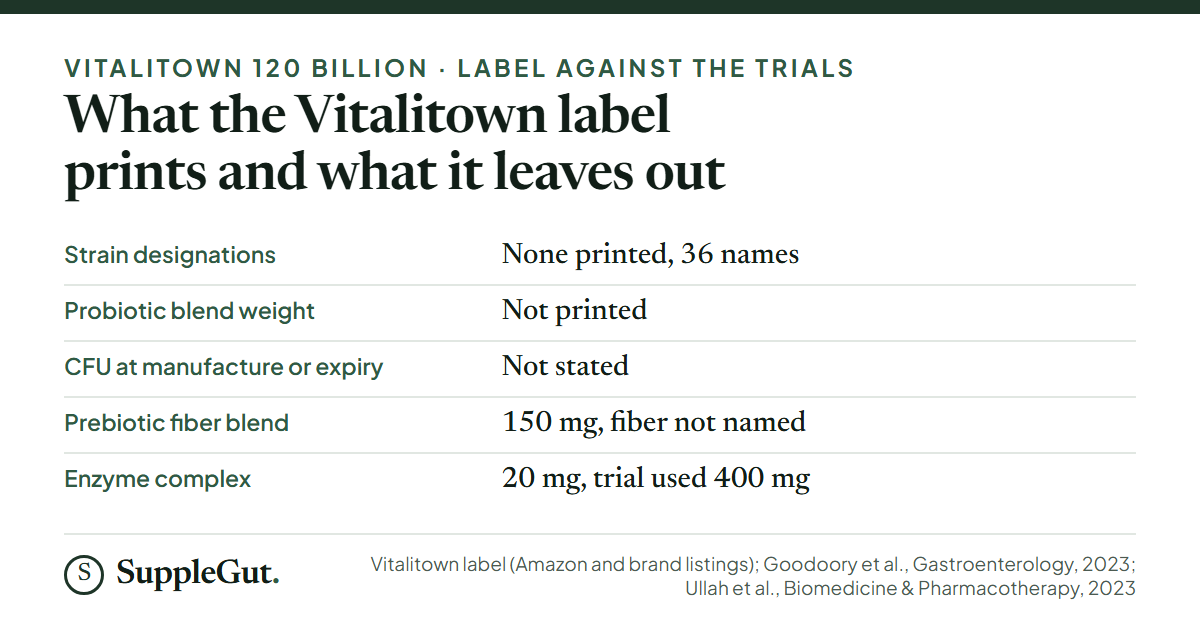
Does Vitalitown 120 Billion work? We could find no trial of Vitalitown 120 Billion itself. The label prints 36 organism names with no strain codes, one 120 billion CFU figure with no blend weight, 150 mg of an unnamed prebiotic blend and 20 mg of 13 enzymes, where the one enzyme trial we found used 400 mg a day. A 2023 meta-analysis of 82 trials rated the certainty of benefit from combination probiotics for bloating as very low. Amazon shows 4.6 from 6,320 ratings shared across every size since 2020; the brand page shows four reviews.
Vitalitown Probiotics 120 Billion is a once-a-day capsule that packs three things into one: a probiotic blend printed as 120 billion CFU across 36 organism names, 150 mg of a prebiotic fiber blend, and 20 mg of 13 digestive enzymes. The numbers on the bottle are large; what the label does not print is the part that matters for judging it. This page sets out what the panel shows, what evidence exists for each of the three parts and at what dose, how the review pool is built, and what the brand’s published terms say.
What Vitalitown 120 Billion is, and what it is not
The Supplement Facts panel lists one capsule as a serving. In it: a probiotic blend of 120 billion CFU, a water-soluble prebiotic fiber blend of 150 mg, and a digestive enzyme complex of 20 mg. The only other ingredient is the cellulose capsule, a delayed-release vegetarian type. The Amazon listing sells 60 capsules to a bottle, and the brand’s own store sells 30 or 60.
The probiotic line is where the panel goes quiet. It names 36 organisms and none carries a strain designation: 21 Lactobacillus names, 7 Bifidobacterium, 3 Lactococcus, 2 Streptococcus, 2 Pediococcus and one Leuconostoc. Several overlap. L. bulgaricus and L. delbrueckii are the same species at different taxonomic ranks, B. lactis and B. animalis likewise, and L. lactis appears alongside Lactococcus lactis. The “36 strains” on the bottle therefore counts names, not named strains, and 36 names is not necessarily 36 distinct species. The blend has no weight printed and no count for any single organism, and the panel does not say whether 120 billion is the count when the capsule was made or when it expires. The label names no source or deposit number for any organism.
The prebiotic blend is not named, so a reader cannot tell whether it is inulin, a galactooligosaccharide, a xylooligosaccharide or something else. The enzyme complex is the most fully described line: amylase (26 DU), glucoamylase (480 AGU), lactase (230 ALU), lipase (120 FCCFIP), papain (1,400 PU), acid protease (200 HUT), neutral protease (140 HUT), beta-glucanase (180 BGU), phytase (130 FTU), cellulase (50 CU), pectinase (48 Endo-PGU), hemicellulase (76 HCU) and xylanase (700 XU). The brand states the product is vegan and free of gluten, dairy, soy, eggs, fish, shellfish, tree nuts and peanuts, in a sentence that covers all Vitalitown products rather than this bottle alone. Sesame is not mentioned.
The trial of the product itself
There is none. We searched PubMed and ClinicalTrials.gov under “Vitalitown” and found no study, and the NIH Dietary Supplement Label Database returns no Vitalitown label. The brand’s site describes the product as “scientifically proven” without citing a study; that is a brand claim, not a result. The brand also says the products are tested by a third party for purity and potency, but names no laboratory, and we found no certificate of analysis and no NSF or USP mark. Everything below is evidence for the ingredient classes, not for this formula.
The evidence for the probiotic blend
The largest review of probiotics for irritable bowel syndrome pooled 82 randomized trials in 10,332 patients, only 24 of them at low risk of bias. For abdominal bloating or distension it rated the certainty of benefit as very low for combination probiotics, the group a 36-name blend belongs to, and found adverse events no higher than on placebo (Goodoory et al., Gastroenterology, 2023). An earlier review of 53 probiotic trials in 5,545 patients said particular combinations, species and strains appeared to help but could not say which (Ford et al., Alimentary Pharmacology & Therapeutics, 2018). The pattern across both is that results attach to defined strains and defined mixtures, and this label defines neither.
A higher-count multi-strain product with a named formula shows how mixed even defined mixtures are. VSL#3, an eight-strain mixture given at doses well above one capsule, lowered flatulence scores against placebo in 48 people with IBS and bloating, while bloating relief and pain did not differ (Kim et al., Neurogastroenterology & Motility, 2005). A 2018 meta-analysis of 5 trials in 243 patients found no significant difference in pain or bloating (VSL#3 meta-analysis, 2018). That is not evidence for or against Vitalitown; it shows that a large count and many strains do not by themselves settle the result. For what a CFU figure does and does not tell you, see how many CFU you need.
The evidence for the enzymes and the prebiotic
The enzyme trial closest to this label tested a fungal-fermentation multi-enzyme blend in 120 adults with functional dyspepsia, double-blind and placebo-controlled for two months. Two capsules a day of 200 mg each, 400 mg a day, improved quality of life, pain and sleep scores against placebo with no side effects reported (Ullah et al., Biomedicine & Pharmacotherapy, 2023). The label here holds 20 mg for the whole complex, one twentieth of the trial’s blend by mass. The two blends are not comparable on composition or activity from the abstract, so the ratio shows a gap in scale, not a verdict. We found no trial of an enzyme-and-probiotic capsule for bloating in people without dyspepsia. For the wider picture on enzymes, see do digestive enzymes work.
The prebiotic blend is 150 mg. Human trials of xylooligosaccharides have used 1.4 to 8 g a day and trials of chicory inulin 12 g a day, so 150 mg sits below the tested range (see the prebiotic references in Sources). Because the fiber is unnamed, even that comparison is approximate. The mechanism is familiar: gut bacteria ferment prebiotic fiber into short-chain fatty acids and gas, so a fiber meant to help can also add gas in some people.
How to take Vitalitown 120 Billion
The product is sold as one delayed-release capsule a day. We found no written directions on the Amazon listing or the brand’s product page, and the bottle’s back label was not visible in the images we read, so whether to take it with food is not stated in what we saw. Storage is given as shelf stable, with refrigeration recommended but not required. A month at one capsule a day is a reasonable first test, since trials of probiotics in IBS typically ran several weeks, but nothing on the label says how long to try it.
Side effects and who should not take it
The only warning in the listing text is to keep the product out of the reach of children, followed by the standard FDA disclaimer. No pregnancy, nursing, medication or medical-condition statement appears in the listing, the brand page or the label images we read, and no age statement was found. Anyone who is pregnant, immunocompromised or taking medication would normally ask a pharmacist or doctor before starting any probiotic; see probiotic side effects for what the trials report. Amazon’s review summary counts 191 mentions of side effects among its topics, but the sign-in wall hid whether they were praise or complaint. In the 2023 meta-analysis above, adverse events with probiotics were no higher than placebo, though that covers other products. One retail reviewer described the capsules as “a little large” and said the surface tends to stick; we could not confirm that on Amazon.
What the reviews say
The rating pool is the first thing to understand. Amazon shows 4.6 from 6,320 ratings: 76% five-star, 14% four, 6% three, 2% two and 2% one. The 30-count and 60-count pages show the same count and split, so the ratings belong to one listing family that has existed since 2020 and covers every size and formula version sold under it, not only the current 60-capsule bottle. Amazon does not show how many are verified purchases. The seller of record on the 60-count is Galaxy Nutrition, with the bottle shipped by Amazon. An import retailer, Desertcart, shows 4.6 from 6,257 reviews, but its numbers track Amazon’s feed and are not a second source.
The brand’s own site shows four reviews, all five stars, marked as verified customers. There is no Trustpilot profile for vitalitown.com and no Better Business Bureau profile for Vitalitown or Galaxy Nutrition. Review text on Amazon is behind a sign-in, so we worked from Amazon’s summary, which calls the product good quality and value, with 36 strains and enzymes that help with digestive issues and bloating, gentle on the stomach and easy to swallow. The topic counts behind it are quality 563, value for money 299, digestive health 249, side effects 191, ease of use 171, effectiveness 132 and variety of strains 126. The brand-site reviews praise the high strain count, value and regularity. The limits are that the sample is large but its text cannot be read from outside, and the direction of the side-effect mentions is unknown.
Who makes it
The label shows no distributor, company name or address. The brand’s site gives a support email and a copyright line reading “Vitalitown”, no legal entity, no founder and no address, and its About page still contains unedited template text. The site invites wholesale accounts from retailers, practitioners and gyms, and states “Loved by 27k+ Customers”, a claim we could not verify. On Amazon the seller is Galaxy Nutrition; a seller-rating tracker lists that seller as active on Amazon since 2018 under an earlier name. No page we read states that Galaxy Nutrition owns the brand, though the brand’s refund policy refers to its “official Amazon seller” and the brand store’s SKUs match the Amazon listing codes. The manufacturer and facility are not named.
Price, subscription and refund terms
Prices by route, at one capsule a day:
| Where and size | Price | Per day |
|---|---|---|
| Amazon, 60 capsules, one time | $32.99 | $0.55 |
| Amazon, 60 capsules, Subscribe & Save | $29.69 | $0.49 |
| Amazon, 2 x 30 capsules | $36.47 | $0.61 |
| Amazon, 30 capsules | $18.99 | $0.63 |
| Brand site, 60 capsules | $52.69 | $0.88 |
| Brand site, 30 capsules | $28.47 | $0.95 |
The brand site ships free in the US and runs a subscription app, but its product page gives no subscription terms. Amazon’s Subscribe & Save carries a first-order coupon whose terms we did not read. We found no billing or cancellation complaints about Vitalitown, but with no Trustpilot or BBB profile and Amazon text behind a sign-in, that is an absence of data rather than evidence either way.
The refund wording differs between sources. The brand’s written policy gives 7 calendar days from the day after delivery to cancel and 7 more to send the item back, unopened, undamaged and in original packaging, with the delivery fee deducted, no refunds on sale items, and requests by email. It says it covers purchases from the brand site or its official Amazon seller. A marketing image on the Amazon listing reads “Love Vitalitown, Or It’s Free” with “no questions asked”, and does not mention the unopened or sale-item conditions. The Amazon listing itself is marked non-returnable for food safety reasons. A single bottle can be bought on Amazon without a subscription.
Who Vitalitown 120 Billion is for
- Someone who wants a probiotic, a small prebiotic dose and enzymes in a single daily capsule, and will judge it by how they feel over several weeks rather than by trial evidence.
- Someone comfortable with a label that names organisms but not strains, and gives a CFU total without a weight or an expiry count.
- Someone who prefers a once-a-day format at about $0.55 a day on the one-time Amazon price.
Where the evidence is more specific, other pages in the catalog differ. Seed DS-01 is a 24-strain synbiotic with a trial on the finished product, covered in its own guide. Enzymedica Digest Gold is an enzyme capsule taken with meals, with no probiotic. MAV Nutrition’s Prebiotics and Probiotics 50 Billion lists 16 species with 1,000 mg of XOS and inulin and no enzymes, at two capsules a day and about $0.73 a day; neither product prints strain codes and no trial compares them. To choose among types, see which probiotic to take, enzymes versus probiotics for bloating, or the quiz, which starts from symptoms.
The products in this catalog
Common questions
Does Vitalitown 120 Billion work?
No trial of this product was found. The label lists 36 organism names without strain codes and one 120 billion CFU figure, and a 2023 meta-analysis of 82 IBS trials rated the certainty of benefit for combination probiotics on bloating as very low. On Amazon 76% of 6,320 ratings are five stars, and Amazon’s summary mentions fewer digestive problems and bloating.
What are the 36 strains in Vitalitown 120 Billion?
The panel prints 36 names: 21 Lactobacillus, 7 Bifidobacterium, 3 Lactococcus, 2 Streptococcus, 2 Pediococcus and one Leuconostoc. None has a strain code, and some overlap, such as L. bulgaricus with L. delbrueckii and B. lactis with B. animalis, so 36 names is not 36 named strains. There is no count for any single organism.
Is 120 billion CFU too much, and do more strains work better?
We found no trial showing that a higher CFU count or a longer list of names gives better results, and no trial of this mixture. The label does not say whether 120 billion is the count at manufacture or at expiry, and the blend has no weight printed. Trial results attach to defined strains and doses; see the CFU guide.
Does Vitalitown 120 Billion have side effects, and who should avoid it?
The listing’s only warning is to keep it out of children’s reach, and no pregnancy or medication statement appeared in the text or label images we read. Amazon counts 191 review mentions of side effects but the direction was hidden behind a sign-in. If you are pregnant, immunocompromised or on medication, ask a pharmacist or doctor first.
How much does Vitalitown 120 Billion cost?
The 60-capsule bottle is $32.99 on Amazon, which is $0.55 a day at one capsule, or $0.49 a day with Subscribe & Save at $29.69. The 30-capsule size is $18.99 on Amazon and $28.47 on the brand site ($0.95 a day); the brand’s 60-capsule size is $52.69 ($0.88 a day).
Who makes Vitalitown, and is the Amazon seller the same company?
The label shows no company name or address, and the brand’s site gives only a support email and a copyright line reading Vitalitown. On Amazon the seller is Galaxy Nutrition, listed by a seller-rating tracker as active since 2018. No page we read states that Galaxy Nutrition owns the brand, although the brand’s refund policy refers to its official Amazon seller.
What is the Vitalitown refund policy?
The brand’s written policy allows 7 calendar days to cancel and 7 more to return the item unopened and undamaged, with no refunds on sale items. A marketing image says “Love Vitalitown, Or It’s Free” and does not mention those conditions. The Amazon listing is marked non-returnable for food safety reasons.
Sources
- Goodoory VC, et al. Meta-analysis of probiotics in irritable bowel syndrome (82 randomized trials, 10,332 patients). Gastroenterology, 2023. PMID 37541528
- Ford AC, et al. Systematic review and network meta-analysis of prebiotics, probiotics, synbiotics and antibiotics in irritable bowel syndrome (53 probiotic trials, 5,545 patients). Alimentary Pharmacology & Therapeutics, 2018. PMID 30294792
- Kim HJ, et al. VSL#3 in irritable bowel syndrome with bloating, 48 patients. Neurogastroenterology & Motility, 2005. PMID 16185307
- VSL#3 in irritable bowel syndrome, meta-analysis of 5 randomized trials in 243 patients, 2018. PMID 30069978
- Ullah H, et al. Multi-enzyme blend in functional dyspepsia, 120 adults, two months. Biomedicine & Pharmacotherapy, 2023. PMID 37976892
- Prebiotic dose references: human trials of xylooligosaccharides and chicory inulin. PMID 24513849; PMID 24661576; PMID 27492975
- Amazon listing: label image, ingredients, price, rating split and seller. amazon.com/dp/B0DM5JD6K6; 30-count listing amazon.com/dp/B088LWDLMV
- Brand page: label, price and product copy. vitalitown.com/products/probiotics-120-billion-cfus
- Brand refund policy. vitalitown.com/policies/refund-policy
Not sure which product fits your situation?
This guide covers the mechanics. The quiz takes your specific symptoms, routine and preferences and matches you to one product from the catalog.
Take the quiz →