
Guide
Do Vitalyra Digestive Enzymes work? Five enzymes with units, three unnamed strains, and a review widget with only five-star cards
Quick answer
Do Vitalyra Digestive Enzymes work? We could find no trial of Vitalyra Digestive Enzymes or its Makzyme-Pro blend. Other multi-enzyme blends improved dyspepsia scores in trials of 120 and 40 adults, and its 300 GALU of alpha galactosidase matches the lower dose that cut symptoms after a bean meal in 8 volunteers, but the three Lactobacillus species carry no count or strain. All 182 reviews sit in a widget on the brand’s own page and all are 5 stars; Trustpilot has none and we found no Amazon listing.
Vitalyra Digestive Enzymes is a one-capsule blend of five digestive enzymes and three Lactobacillus species, from the brand that sells Vitalyra Gut Health 4in1. What sets it apart on the shelf is that the panel prints an activity unit for each of the five single enzymes; what it leaves out is any count or strain code for the bacteria. This page covers the label, the evidence, the directions, the price and the reviews.
What Vitalyra Digestive Enzymes is, and what the label prints
The brand sells a 60-capsule bottle of vegetable capsules, with a serving of one capsule. The Supplement Facts panel lists six lines.
| Line as printed | Per capsule |
|---|---|
| Makzyme-Pro™ (fungal protease from Aspergillus oryzae, plus Lactobacillus acidophilus, casei and plantarum) | 2,500 HUT / 400 mg |
| Bromelain | 90 GDU |
| Papain | 2,670 TU |
| Fungal lipase | 1,500 FIP |
| Fungal lactase | 600 LACU |
| Alpha galactosidase | 300 GALU |
The first line is one 400 mg weight that holds the protease and the three bacteria together, so the milligrams of each cannot be read. No CFU is printed for any of the three species, none carries a strain designation, and there is no statement that the bacteria are alive at expiry. The panel carries no allergen line; the brand’s page says the formula is free from soy, gluten and dairy, and egg, tree nuts, fish and sesame are not addressed. The label has no ingredient-specific warning for the fruit-derived bromelain or papain.
The brand states “Third Party Tested” and “Made in USA” on the page and shows a “GMP certified facility” seal on the bottle, and it names no laboratory, certificate or batch result.
Two numbers for one enzyme
The typed text on the brand page gives alpha galactosidase as 3000 GALU. The panel image gives 300 GALU, a tenth of that. We have used the panel image for every figure on this page. The typed figure would sit above both doses tested in the bean-meal trial below.
The trial of the product itself
We could find none. ClinicalTrials.gov returned no study for “Makzyme”, PubMed returned no paper for it, and the brand’s section headed “Science-Backed Digestive Health Formula” cites nothing. The evidence below comes from other products and other doses.
The evidence for the ingredients
Multi-enzyme blends. Two placebo-controlled trials tested different blends in functional dyspepsia. One enrolled 120 adults and gave a fungal-fermentation blend at 200 mg per capsule, two capsules a day, for two months; dyspepsia, pain and sleep scores improved against placebo. The other enrolled 40 patients and gave the branded blend DigeZyme at 50 mg three times a day for 60 days, with significant differences on all dyspepsia scales (p from 0.0401 to 0.0033). Neither blend is this one, and neither contained Lactobacillus. A narrative review found mostly positive trials of enzyme preparations for after-meal symptoms, none designed to show which component does what.
Alpha galactosidase. In a double-blind crossover of 8 healthy volunteers eating a 420 g cooked-bean meal, 1,200 GALU reduced breath hydrogen and flatulence, and both 300 and 1,200 GALU reduced the total symptom score against placebo. One capsule here carries 300 GALU, the lower of those doses. In 125 people with IBS and bloating or flatulence, alpha galactosidase at meals for 12 weeks showed only a trend on symptom severity, more people left the enzyme group (18 against 7, p = 0.016), and the authors found no evidence to support routine use in IBS.
Lactase. A randomized crossover trial in 47 adults with breath-test-confirmed lactose intolerance found that lactase chewable tablets cut cumulative breath hydrogen by 55% and lowered symptom scores. The abstract gives no lactase dose, so 600 LACU is not compared with it here.
Bromelain, papain, lipase and protease. We found no controlled trial of oral bromelain or papain for digestive symptoms; the one hit in our PubMed search was a study of lumbar osteoarthritis.
The bacteria. With no count and no strain printed for L. acidophilus, casei or plantarum, no probiotic trial can be matched to the label. The digestive enzymes guide covers where enzyme trials are strongest.
Against ElevenZyme and Physician’s CHOICE
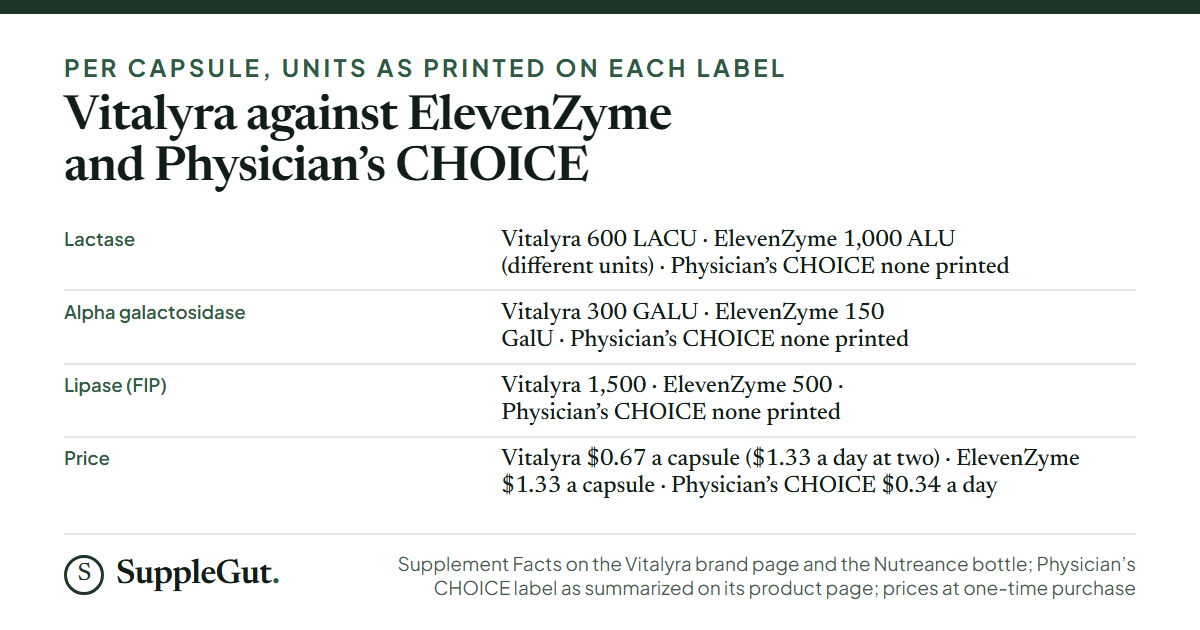
Nutreance ElevenZyme prints a unit for each of eleven enzymes inside a 110 mg blend (guide): 1,000 ALU of lactase, 150 GalU of alpha-galactosidase and 500 FIP of lipase, at $1.33 a capsule. Vitalyra prints 600 LACU, 300 GALU and 1,500 FIP, at $0.67 a capsule on the $39.99 bottle. Lactase is in different units on the two labels (LACU and ALU), so those figures do not compare directly. Physician’s CHOICE Multi Enzymes lists sixteen enzymes with no amount for any of them, at about $0.34 a day in the catalog.
How to take Vitalyra Digestive Enzymes
The brand’s page gives three instructions. The serving details say one capsule twice a day, 20 to 30 minutes before a meal. The how-to line says one capsule with a glass of water during a meal. A third line says an additional serving can be taken with larger meals. The label says not to take the product within one hour of taking medications, and not to exceed the recommended dose. At two capsules a day a bottle lasts 30 days; at one a day, 60.
Side effects and who should check first
No side-effect list is printed on the brand page. The label says that pregnant or nursing mothers, children under 18, anyone taking medication and anyone with a medical condition should consult a physician, and that the product is for adults only. We found no independent review that reports a reaction, because we found no independent review at all.
What the reviews say
- Brand page, Stamped review widget: 5.00 from 182 reviews, hosted on the brand’s own page. All 182 are five stars and all are marked as verified buyers in the United States.
- Brand page, typed text: “Rated 4.9/5 from +300 reviews”, which matches neither the widget’s 182 nor its 5.00.
- Amazon: we found no listing for this product. The brand’s Amazon store lists 20 items, none of them the enzymes.
- Trustpilot: a claimed profile for vitalyrahealth.com with no reviews.
The widget’s review ids fall in runs of consecutive numbers: 79 of the 182 sit within one range of 90 ids, and 38 within another range of 42. By month, 79 reviews are dated September to November 2024, 65 fall between January and July 2025, and 38 fall in 2026 at one to seven a month; the feed holds no recent reviews. The same review account reports 6,449 reviews across all of the brand’s products.
As a tally of words, not a sentiment score, “bloat” appears in 33 of the 182 reviews, “stomach” in 19 and “gas” in 16. The recurring praise is less bloating, a lighter feeling after meals, and the probiotics added to the enzymes. No review below five stars exists in any source we read, so there is no recurring complaint to report.
Price, subscriptions and the refund terms
| Route on the brand site | Price | Per day at two capsules |
|---|---|---|
| One bottle, one time | $39.99 (listed regular price $69.99) | $1.33 |
| Three bottles | $104.97 | $1.17 |
| Six bottles | $179.94 | $1.00 |
| Subscription, one bottle a month | $34.99 | $1.17 |
| Subscription, two or three bottles | $29.99 or $24.99 each | $1.00 or $0.83 |
At the one-capsule-a-day line in the how-to text, the one-time bottle comes to $0.67 a day. The brand’s product feed holds five near-identical records, with one-bottle prices of $39.99 on four and $49.95 on the fifth. The page describes the subscription as “cancel or pause anytime”.
The brand states a 60-day money-back guarantee. Its refund policy says a single item is refunded in full if requested within 60 days of delivery, whatever the amount used, and not more than twice a year per household. For a bundle or an entire order, the refund is 50% of the order minus shipping. A single bottle can be bought one time, so a bundle or subscription is not required.
Search results show the same ingredient list and units sold under other names, including “Digestive Enzyme Pro Blend” and a listing under the Olympian Labs name that uses the term Makzyme-Pro. We did not open those pages.
Who Vitalyra Digestive Enzymes is for
- Someone who wants five enzymes with printed units in one capsule and accepts that the three bacteria come with no count or strain.
- Someone whose trigger is a bean-heavy or dairy-heavy meal, where the alpha galactosidase and lactase trials sit, knowing the IBS trial found no routine benefit.
For bloating that does not follow particular meals, the enzymes against probiotics guide compares the approaches, and the quiz starts from symptoms.
The products in this catalog
Common questions
Do Vitalyra Digestive Enzymes work?
No trial of this product was found. Other multi-enzyme blends improved functional dyspepsia scores in two placebo-controlled trials of 120 and 40 adults, and alpha galactosidase at the 300 GALU on this label reduced symptoms after a bean meal in 8 healthy volunteers. The only reviews found are on the brand’s own page, and all 182 are 5 stars.
What is in Vitalyra Digestive Enzymes?
One capsule has a 400 mg Makzyme-Pro line (2,500 HUT of fungal protease with Lactobacillus acidophilus, casei and plantarum), bromelain 90 GDU, papain 2,670 TU, fungal lipase 1,500 FIP, fungal lactase 600 LACU and alpha galactosidase 300 GALU. No CFU or strain code is printed for the three bacteria.
Is the alpha galactosidase 300 GALU or 3000 GALU?
The panel image prints 300 GALU. The brand page’s typed text prints 3000 GALU, ten times as much, and the two have not been reconciled. The bean-meal trial tested 300 and 1,200 GALU, so the typed figure would sit above both.
How many Vitalyra Digestive Enzymes capsules a day, and when?
The brand page disagrees with itself. The serving details say one capsule twice a day, 20 to 30 minutes before a meal, the how-to line says one capsule with a meal, and a third line allows an additional serving with larger meals. The label says not to take the product within one hour of medications.
How much do Vitalyra Digestive Enzymes cost?
A 60-capsule bottle is $39.99 on the brand site, or $34.99 a month on subscription. At two capsules a day it is a 30-day supply, about $1.33 a day ($1.17 on subscription); at one a day it would be about $0.67.
Are there side effects, and who should check first?
The brand page prints no side-effect list. It says pregnant or nursing mothers, anyone under 18 and people with a medical condition should consult a physician, and that the product should not be taken within one hour of medications. It states the formula is free from soy, gluten and dairy.
What are the refund terms, and are the reviews independent?
The brand offers 60 days: a full refund for a single item, but 50% of the order minus shipping for a bundle or entire order. All 182 reviews sit in a widget on the brand’s own page and all are 5 stars; Trustpilot shows none and we found no Amazon listing for this product.
Sources
- Ullah H, et al. A multi-enzyme blend from fungal fermentation in 120 adults with functional dyspepsia: randomized, double-blind, placebo-controlled trial. Biomedicine and Pharmacotherapy, 2023. PMID 37976892
- Majeed M, et al. DigeZyme multienzyme complex in functional dyspepsia: randomized, double-blind, placebo-controlled trial in 40 patients. Journal of Medicinal Food, 2018. PMID 30156436
- Graham DY, et al. Enzyme therapy for post-prandial distress: narrative review of multi-enzyme preparations. Journal of Digestive Diseases, 2018. PMID 30101562
- Di Stefano M, et al. Oral alpha-galactosidase and gas after a bean meal: double-blind crossover in 8 healthy volunteers. Digestive Diseases and Sciences, 2007. PMID 17151807
- Hillílä M, et al. Alpha-galactosidase in 125 people with irritable bowel syndrome. Scandinavian Journal of Gastroenterology, 2015. PMID 26133538
- Baijal R, et al. Lactase in lactose intolerance: randomized crossover placebo-controlled trial in 47 adults. JGH Open, 2021. PMID 33490624
- PubMed search for oral bromelain and papain in digestive symptoms (one hit, a lumbar osteoarthritis study). PMID 32122870; ClinicalTrials.gov query for “Makzyme” (no studies). clinicaltrials.gov
- Brand page: label panel, directions, warnings, price and review widget; refund policy. vitalyrahealth.com/products/vitalyra-digestive-enzymes; vitalyrahealth.com/policies/refund-policy
- Amazon store page for the brand and the Trustpilot profile for vitalyrahealth.com. amazon.com store page; trustpilot.com/review/vitalyrahealth.com
Not sure which product fits your situation?
This guide covers the mechanics. The quiz takes your specific symptoms, routine and preferences and matches you to one product from the catalog.
Take the quiz →