
Guide
Does BelliWelli fiber powder work? Four grams of acacia, a named strain at half the trial dose, and a registered trial with no results
Quick answer
Does BelliWelli fiber powder work? No published trial of the powder was found; the brand’s registered 12-week trial was registered after it finished, lists 50 participants against 100 in its description and has no results posted. One scoop has 4 g of acacia fiber, the only fiber, against 10 g a day in the 180-person IBS-C trial, and 1 billion CFU of Bacillus coagulans MTCC 5856, half the 2 billion in the 70-adult gas-and-bloating trial. No trial in people taking GLP-1 medicines was found. Amazon shows 4.3 from 2,013 ratings.
BelliWelli Daily Fiber + Probiotics is a flavored drink-mix powder, sold in Strawberry Lemonade and five other flavors, that puts 4 g of acacia fiber and one strain of Bacillus coagulans in an 11.3 g scoop, with collagen and a few minerals. What sets it apart from the fiber on the next shelf is the marketing: the Amazon title and the brand’s pages pitch it for people taking GLP-1 medicines.
What BelliWelli fiber powder is, and what it is not
One scoop (11.3 g) is listed at 25 calories, 4 g of dietary fiber (14% of the daily value), 2 g of added sugar and 2 g of protein. The fiber has one source, acacia fiber at 4.0 g. The panel also prints Bacillus coagulans MTCC 5856 at 10 mg, stated as 1 billion CFU, 2 g of bovine collagen peptides, 7.5 mg of niacin, and magnesium, sodium, potassium, calcium and iron that the brand rounds to “278mg electrolytes”. The sugar is organic cane sugar, with stevia.
Three details matter. The collagen is bovine, so the powder is not vegetarian, even though Amazon’s diet field says it is. The label has no allergen statement that we could find. And the ingredients text on the brand’s product page names allulose, pectin and coconut-derived MCTs, none of which appears on the powder’s panel; that text may belong to the brand’s gummies, which share the page layout, and the panel is taken as the label here. The brand states that every batch is third-party tested and names no laboratory or testing mark.
The strain is named, which most probiotic labels leave out, and the label does not say whether 1 billion CFU is the amount at manufacture or at expiry.
The trial of the product itself
There is no published trial of the powder. There is a registered one. NCT07755735, sponsored by Belli Welli Inc. with Citruslabs as collaborator, describes a triple-blind, placebo-controlled trial of 12 weeks in which the active arm took the amounts on this panel twice a day, which is 8 g of acacia fiber and 2 billion CFU a day, against a maltodextrin-and-sugar placebo. Participants were adults with self-reported bloating, irregular bowel movements and poor gut health; people with IBS, IBD or acid reflux, and vegans, were excluded.
The status is completed, but the entry was registered after the trial had been completed. The listed enrollment is 50, while its description says 100. No results are posted, and PubMed has no paper under the brand’s name.
The brand’s science page describes “a 100-person trial” by Citrus Labs and gives the share of participants who reported improvement in bowel movements, gut health, digestive comfort and bloating. These are the brand’s figures, self-reported and sponsor-funded, with no authors, year or link, and the registry has no results to check them against; they are not repeated here.
The evidence for the ingredients
The two active ingredients each have a trial, and in both the dose is larger than one scoop.
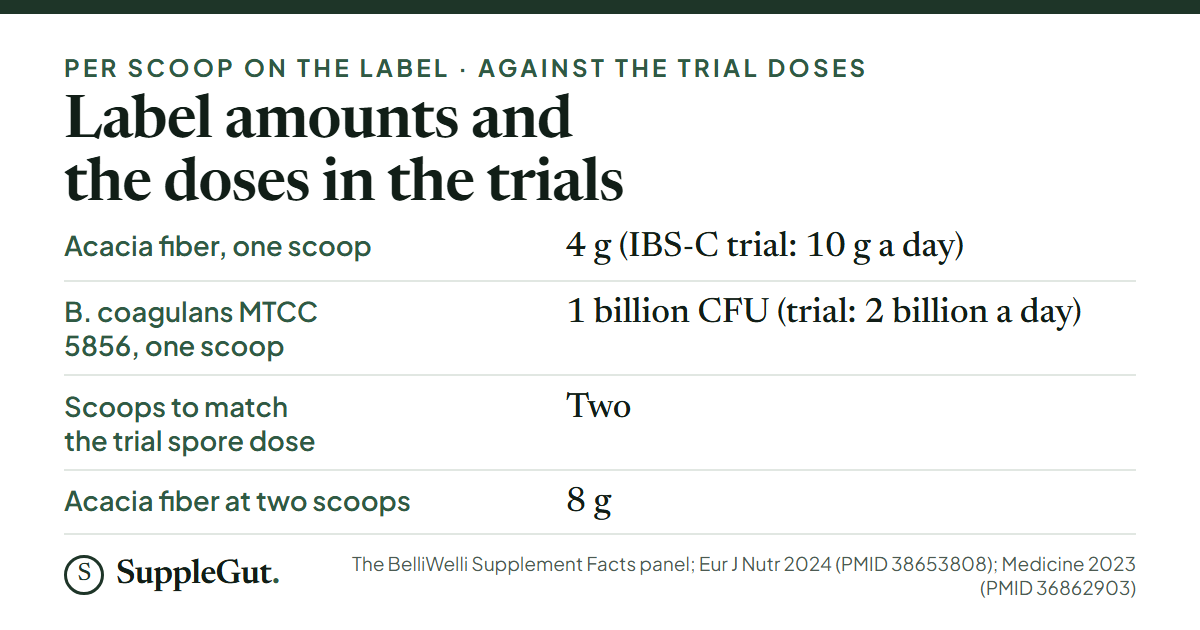
Acacia fiber. The closest trial is in constipation-predominant IBS: 180 adults with Rome IV IBS-C took 10 g a day of acacia fiber or maltodextrin for four weeks in a randomized, double-blind trial. Stool frequency improved against placebo (P < 0.001); stool consistency, stool mass and quality of life did not change significantly, and constipation symptoms showed only a trend (P = 0.10). One author is employed by the fiber’s supplier. One scoop here gives 4 g and two scoops 8 g. A dose-ranging study of gum arabic (acacia fiber) in healthy volunteers raised bifidobacteria and lactobacilli over water at four weeks, with the authors putting the optimal dose at around 10 g; one scoop is 40% of that.
Bacillus coagulans MTCC 5856. A randomized, double-blind, placebo-controlled trial in 70 adults with functional gas and bloating gave 2 billion spores a day for four weeks. The GSRS indigestion score fell from 8.91 to 3.06 on the strain against 9.42 to 8.43 on placebo (P < 0.001 against P = 0.11), with no adverse events reported. One scoop is 1 billion CFU, half that dose; two scoops match it.
Matching the trial spore dose takes two scoops a day, as in the brand’s registered trial. The label’s serving is one scoop.
The GLP-1 claim
The Amazon title says “GLP-1 Support”, and the brand’s pages carry a section headed “BelliWelli + GLP-1”. The reasoning is that GLP-1 medicines can slow digestion and cause constipation, that a smaller appetite can lower fiber intake, and that fiber may help with fullness. That is the brand’s argument, stated without a citation. We found no trial of this product, or of any fiber supplement, in people taking GLP-1 medicines, and the registered trial lists neither GLP-1 use nor weight as an inclusion criterion or outcome in the text we read. For other powders marketed on the same idea, see the guides to OMYO and GLP-1 SOS.
How to take it
The panel is per scoop. Amazon’s directions say to stir or whisk one scoop into 10 to 12 ounces of water; the brand’s FAQ says “anywhere from 1-4 scoops a day” and its page counts 8 g of fiber in two scoops. We found no instruction about timing or food.
Side effects and who should not take it
Acacia is a fermentable fiber, so gas and bloating can occur in some people while the gut adjusts. On Amazon, 25 of 159 mentions of digestive effects are negative, and one reviewer describes the first few days as rough. Amazon’s page advises plenty of fluids. The panel graphics carry no pregnancy, medication or age statement, though the physical label was not seen. A different version of the label (Tropical Breeze, in the NIH Dietary Supplement Label Database) carries a California Proposition 65 statement naming lead; the Strawberry Lemonade graphics show only the panel, so whether that flavor carries the same wording is not known. Anyone taking a prescription medicine, including a GLP-1 medicine, or who has a bowel condition, should check with a prescriber first.
What the reviews say
Amazon shows 4.3 from 2,013 ratings: 70% give five stars, 11% four, 8% three, 4% two and 7% one. The brand’s own site shows 4.7 from 857 reviews through a widget the brand hosts. Trustpilot has an unclaimed profile with no reviews, and a Walmart rating could not be verified because the page sits behind a verification wall.
Amazon’s summary of review text counts mentions by topic: effectiveness 170 positive and 36 negative of 206, taste 349 positive and 88 negative of 437. The praise is for the taste, for more regular bowel movements and less bloating, and for a powder that dissolves in water. The recurring complaints are three: some find it too sweet; some report clumps even after shaking (32 of 118 mentions of dissolving are negative); and on value, 36 of 76 mentions are negative, with reviewers noting the tub holds less than a month at a scoop a day. No complaint about unexpected charges or refused refunds appeared in the reviews we read, a small sample and not a billing record.
Cost, subscription and refund terms
| Route | Price | Per day at one scoop |
|---|---|---|
| Amazon, 16 servings | $19.98 | $1.25 |
| Amazon Subscribe & Save (10% off) | $17.98 | $1.12 |
| Brand site, 30-serving tub, one time | $44.99 | $1.50 |
| Brand subscription, first order | $29.64 | $0.99 |
| Brand subscription, later orders (15% off) | $38.24 | $1.27 |
At two scoops a day, the brand’s trial amount, each figure doubles: about $2.50 a day on Amazon at the one-time price. The brand’s subscription says “cancel anytime”, with the 61% discount on the first order only and 15% off after. Its refund policy allows a return within 30 days of delivery if the order is unopened; the customer pays return shipping, and the policy does not mention subscriptions. Amazon lists the powder as non-returnable unless it arrives damaged or defective.
Who it is for
- Someone who wants a flavored fiber drink at about 4 g a serving, with the amount adjustable by the scoop.
- A shopper weighing the GLP-1 pitch, which is the brand’s reasoning and not a tested result.
- Someone who wants a named spore probiotic in the same drink, at 1 billion CFU a scoop against 2 billion in the gas-and-bloating trial.
For plain acacia fiber by the gram, see the NOW Acacia Pure Powder page; the LOAM guide covers a multi-fiber blend. If gas and bloating are the main complaint, the bloating guide starts from the cause instead of the product, and the quiz narrows the field by symptom.
The products in this catalog
Common questions
Does BelliWelli fiber powder work?
No published trial of the powder was found. The brand registered a 12-week placebo-controlled trial of the formula, but it was registered after it finished, lists 50 participants against 100 in its description and has no results posted. Acacia fiber improved stool frequency in 180 adults with IBS-C at 10 g a day, and one scoop here has 4 g. On Amazon, 170 of 206 effectiveness mentions are positive.
What is in BelliWelli fiber powder?
One 11.3 g scoop has 4 g of acacia fiber (the only fiber), 1 billion CFU of Bacillus coagulans MTCC 5856, 2 g of bovine collagen peptides, about 280 mg of minerals and 2 g of added sugar from cane sugar plus stevia. The collagen means it is not vegetarian. The brand’s ingredients text names allulose, pectin and MCTs that the powder’s panel does not.
Is BelliWelli good for people on GLP-1 medications?
The Amazon title and the brand’s pages market it for GLP-1 users, reasoning that those medicines can slow digestion and cause constipation. That is the brand’s argument, and no trial of this product, or of a fiber supplement, in people taking GLP-1 medicines was found. People on these medicines should ask their prescriber. The OMYO guide covers another powder sold on the same idea.
Does BelliWelli cause gas or bloating?
Acacia is a fermentable fiber, so gas can occur in some people while the gut adjusts, and one reviewer describes the first few days as rough. On Amazon, 25 of 159 mentions of digestive effects are negative. The label advises drinking plenty of fluids to avoid constipation.
How much does BelliWelli cost, and is the dose in the trials?
Amazon lists 16 servings at $19.98, or $1.25 a day, and $1.12 with Subscribe & Save. The brand’s 30-serving tub is $44.99 ($1.50 a day), with a first subscription order at $29.64 and 15% off after. The trial doses of both ingredients need two scoops a day, which doubles those figures.
Does BelliWelli have a refund policy and a subscription?
The brand allows returns within 30 days of delivery for unopened orders; the customer pays return shipping and the original shipping charge is not refunded. Its subscription says cancel anytime. Amazon lists the powder as non-returnable unless damaged or defective, and no billing complaints appeared in the reviews we read.
Is BelliWelli powder safe, and what about the lead warning?
The panel graphics we read carry no pregnancy, medication or age statement, and the physical label was not seen. A different version of the label in the NIH database carries a California Proposition 65 statement naming lead; whether the Strawberry Lemonade flavor carries the same wording is not known from what we read. The brand says every batch is third-party tested but names no laboratory.
Sources
- Bacillus coagulans MTCC 5856 in adults with functional gas and bloating: randomized, double-blind, placebo-controlled trial, 70 adults, 2 billion spores a day for four weeks. Medicine, 2023 (PMID 36862903). pubmed.ncbi.nlm.nih.gov/36862903
- Acacia fiber at 10 g a day against maltodextrin in 180 adults with IBS-C, four weeks. European Journal of Nutrition, 2024 (PMID 38653808). pubmed.ncbi.nlm.nih.gov/38653808
- Calame W, et al. Gum arabic as a prebiotic in healthy volunteers at 5, 10, 20 and 40 g a day. British Journal of Nutrition, 2008 (PMID 18466655). pubmed.ncbi.nlm.nih.gov/18466655
- ClinicalTrials.gov registry entry NCT07755735, “A Study to Evaluate the Effects of a Fiber Supplement on Gut Health”. clinicaltrials.gov/study/NCT07755735
- BelliWelli brand pages: product page (label, directions, price, subscription terms), science page and refund policy. belliwelli.com
- Amazon listing: title, Supplement Facts image, ratings, review summary, price and return terms. amazon.com
- NIH Dietary Supplement Label Database, record 323047 (a different version of the powder): label text including the California warning. api.ods.od.nih.gov
- Trustpilot profile for belliwelli.com. trustpilot.com
Not sure which product fits your situation?
This guide covers the mechanics. The quiz takes your specific symptoms, routine and preferences and matches you to one product from the catalog.
Take the quiz →