
Guide
Does Belly Bliss tea work? Eight herbs, no amounts, and what the peppermint and ginger trials used
Quick answer
Does Belly Bliss work? No trial of the tea was found. The peppermint evidence is for oil capsules in IBS, rated very low quality, and the ginger trial gave 1.2 g in capsules to 11 people; neither was a tea. The label lists eight herbs with no amounts, which works out to about 2.1 to 2.8 g of whole blend per teaspoon, against European traditional-use doses of 1.5 to 5 g per cup for single herbs. On the brand’s own site it scores 4.95 from 22 reviews, with no independent rating.
Belly Bliss is a loose-leaf herbal tea from Haya Herbs, a small Shopify tea brand, sold as a “Digestion Tea” for bloating, acid reflux, constipation and IBS. It is made of eight herbs: ginger, chamomile, peppermint, spearmint, marshmallow root, fennel, clove and cardamom. It is a tea, not a capsule or a tincture, so there is no Supplement Facts panel and no printed amount for any herb. This page sets out what is in the cup, what the peppermint and ginger trials actually tested, what the brand’s claims rest on, and what the reviews on the brand’s own site show.
What Belly Bliss is, and what it is not
The brand’s page lists the ingredients as ginger, chamomile, peppermint, spearmint, marshmallow root, fennel, clove and cardamom powder. No amount, order of predominance or plant part is printed for any of the eight, and no blend weight is given. The sourcing text says the herbs are grown without pesticides or chemicals and that there are no fillers or synthetics. The page carries no allergen statement, no gluten or caffeine statement, and names no laboratory, certification or manufacturer. The only regulatory text is the standard line that the statements have not been evaluated by the U.S. Food and Drug Administration, plus a general request to consult a physician before starting new herbs.
It is not a probiotic, a fiber or a peppermint oil capsule such as IBgard. That last difference matters more than any other fact about this product, and the sections below explain why.
The trial of the tea itself
There is none. We searched PubMed for the product name and for the brand, and ClinicalTrials.gov for the brand; neither returned a study of Belly Bliss or of an eight-herb blend of this composition. Every claim about the tea therefore rests on evidence for single herbs or for other herbal products, usually concentrated oils or extracts, and on how closely that evidence matches what is in the cup.
Peppermint leaf is not peppermint oil
The strongest gut evidence in this blend belongs to an ingredient form that is not in it. A 2022 meta-analysis pooled 10 randomized trials in 1,030 people with IBS and found peppermint oil beat placebo for overall symptoms (relative risk of not improving 0.65, 95% confidence interval 0.43 to 0.98, number needed to treat 4) and for abdominal pain (relative risk 0.76, 0.62 to 0.93, number needed to treat 7). Adverse events were more frequent on peppermint oil (relative risk 1.57, 1.04 to 2.37), and the authors rated the quality of the evidence very low (Ingrosso et al., Alimentary Pharmacology & Therapeutics, 2022). A review of 33 double-blind placebo-controlled trials of Western herbal medicines in IBS found peppermint essential oil, aloe vera and asafoetida effective in meta-analyses, while other formulas, including a curcumin and fennel oil combination, showed benefit in single trials that had not been replicated (Hawrelak et al., Complementary Therapies in Medicine, 2020).
Those trials used oil, mostly in capsules. A hot-water infusion of leaf extracts much less oil than a capsule holds, and we found no randomized trial of peppermint or spearmint tea for bloating, constipation or reflux. The Cochrane review of herbal medicines for functional dyspepsia reports that peppermint plus caraway oil probably improved global symptoms at four weeks, and that the liquid multi-herb extract STW 5, which includes chamomile and peppermint, may moderately improve them, with very uncertain evidence (Báez et al., 2023). Both are different preparations from a steeped tea, and both were studied in dyspepsia, not general bloating. The IBgard guide covers the capsule trials in detail.
The ginger trial used a capsule and one dose
The ginger study in the sources we read was a randomized double-blind crossover trial in 11 patients with functional dyspepsia. A single dose of 1.2 g of ginger in capsules sped gastric half-emptying (12.3 minutes against 16.1 on placebo), and it made no difference to gastrointestinal symptoms (Hu et al., World Journal of Gastroenterology, 2011). One teaspoon of Belly Bliss holds at most about 2.1 to 2.8 g of the whole blend, and the brand does not say how much of it is ginger. The trial tested a capsule, one time, in eleven people; it is not a trial of ginger tea.
For fennel, the one trial in the sources we read used fennel essential oil combined with curcumin in people with IBS, and it reported better symptoms and quality of life (Portincasa et al., 2016). That is an oil with a second active ingredient, not fennel seed in a cup. We found no trial of marshmallow root, clove, cardamom or spearmint tea for these outcomes, and none of chamomile tea alone.
How much is actually in a cup
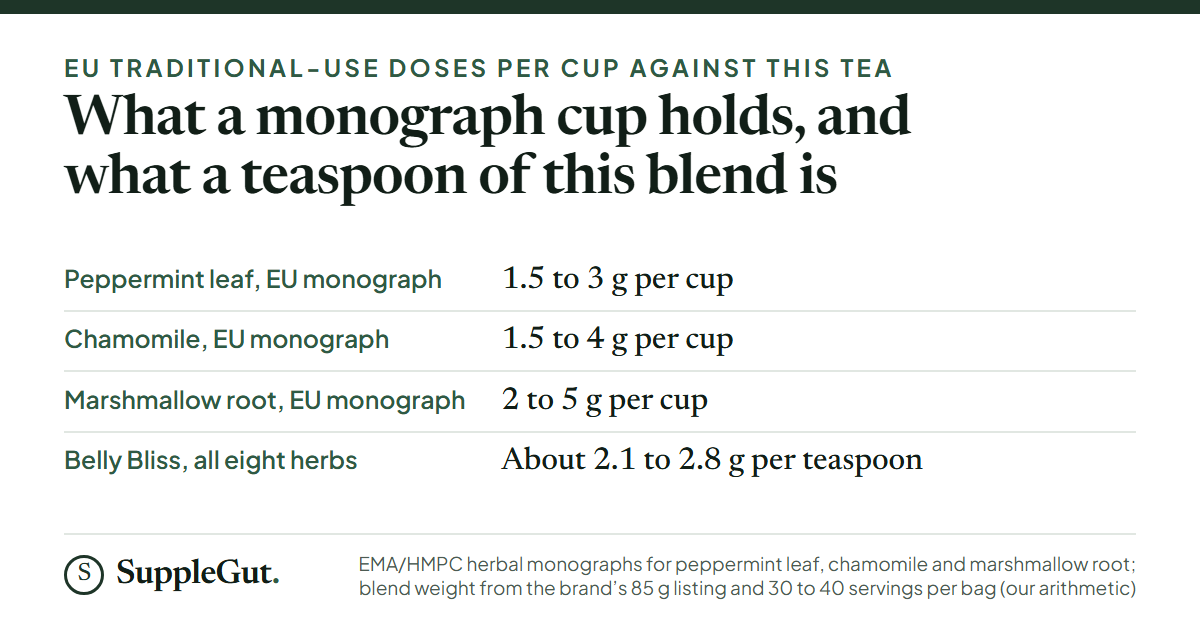
The brand says one bag gives 30 to 40 servings at one teaspoon per 8 fl oz cup, and the listing weight is 85 g. By our arithmetic that is at most about 2.1 to 2.8 g of the whole blend per teaspoon (85 divided by 40 and by 30). The 85 g is a shipping weight and may include packaging, so the true figure could be lower. Spread across eight herbs, an equal split, which the brand does not state, would be roughly 0.26 to 0.35 g of each herb a cup.
The nearest official reference for what a cup of a single herb is meant to hold is the European Medicines Agency herbal monograph, which records traditional use, long-standing use rather than proven efficacy. Those monographs give 1.5 to 3 g per cup for peppermint leaf, 1.5 to 4 g for chamomile and 2 to 5 g for marshmallow root, the last prepared as a cold-water macerate rather than a boiling-water infusion. A teaspoon of an eight-herb blend sits at or below the dose of any one of those herbs on its own. That does not mean the tea does nothing, and a brewed cup is not the same preparation as the monograph’s. It does mean the traditional-use doses are not the doses this tea can be shown to deliver, and the trial doses of peppermint oil and ginger are different materials altogether. For the same comparison on another herbal tea, see the Happy Intestine Tea guide.
The brand’s other claims
The product page lists what Belly Bliss “naturally supports”: soothing bloating and stomach aches, regularity, post-meal digestion and relieving constipation, and also stomach ulcers, leaky gut and cleansing the stomach of parasites. The listing text adds that the blend works to calm inflammation and neutralize acid. The ulcer, leaky gut, parasite and acid claims name conditions or mechanisms, and we found no trial behind them in PubMed or ClinicalTrials.gov. On acid, the European peppermint leaf monograph says people with gastroesophageal reflux should avoid peppermint leaf preparations because heartburn may increase, which points the opposite way from a reflux claim. These are the brand’s statements, not findings.
How to take it
The brand’s directions: measure 1 teaspoon of blend per 8 fl oz of boiling spring or filtered water, steep 10 to 12 minutes, strain, and drink warm or at room temperature, 1 to 2 cups a day, either after meals or first thing in the morning. It recommends drinking it for at least a month and says one bag is about a month’s supply. At two cups a day a bag lasts roughly 15 to 20 days. One reviewer on the brand’s page says taking more than directed emptied the bag early.
Side effects and who should check first
The product page has no pregnancy, nursing or medication warning. The European monographs for the herbs in it do:
- Pregnancy and breastfeeding. The monographs for peppermint leaf and chamomile say use is not recommended because safety data are lacking.
- Medicines. The marshmallow root monograph says absorption of other medicines may be delayed and advises spacing them 30 to 60 minutes apart.
- Heartburn or reflux. The peppermint leaf monograph advises people with reflux to avoid it, and urges caution with gallstones.
- Daisy-family allergy. Chamomile is in the Asteraceae family, and its monograph lists hypersensitivity to that family as a contraindication; this applies to people allergic to ragweed, daisies or chrysanthemums.
We did not read the monographs for ginger, spearmint, fennel, clove or cardamom. None of the 22 reviews on the brand’s page reports a side effect; one says the clove taste took some getting used to. Anyone with ongoing bowel symptoms, blood in the stool or unexplained weight loss needs a diagnosis rather than a tea.
What the reviews say
The brand’s own product page shows 4.95 out of 5 from 22 reviews: 21 five-star and one four-star, none lower, with 13 marked as verified buyers and 9 not. These are Judge.me reviews on the brand’s own store, and none is flagged as incentivized. We found no independent rating: there is no Amazon listing for Belly Bliss, no Trustpilot profile and no Better Business Bureau profile for the brand. The brand’s home page cites 519 reviews, but that figure covers every product, not Belly Bliss.
The recurring praise is less bloating and post-meal discomfort (about 9 of the 22 reviews), more regular bowel movements or relief from constipation (about 5), and flavor or an evening routine (about 9). Several mention IBS or acid reflux. These are self-reported, with no comparison group. The complaints are few: a bag that ran out early, and a clove taste that needed getting used to. One five-star review describes watching parasites leave the body, which repeats the brand’s own claim and is an anecdote. With 21 of 22 reviews at five stars and no independent source, the rating shows how the brand’s own reviewers rated it and little more.
Price, subscription and refunds
One bag is $27.00, which is about $0.90 a day at one cup a day and 30 servings, $0.68 at 40 servings, and $1.35 to $1.80 a day at two cups. A subscription takes 10% off, to $24.30, delivered every one to four months, about $0.81 a day at 30 servings. Shipping is free on US orders of $95 and over. Belly Bliss is also part of the brand’s Digest & Detox Bundle at $122.00.
The brand’s published refund policy says all sales are final and that it does not accept returns or issue refunds on any products. Orders cannot be canceled or modified after 24 hours, and missing or damaged items must be reported within 48 hours with photos for a replacement or store credit. The subscription terms appear as a checkbox line on the product page linking to that policy; we found no separate instructions for canceling a subscription.
Who makes Belly Bliss, and what is the Candida Cleanse?
The site is operated by Haya Herbs Tea, LLC. The brand describes its founder as a biologist, herbalist and Ayurveda practitioner with over 10 years of experience, without naming credentials, and lists no street address. It sells a wide range of teas and tinctures at $25 to $30. As far as we found, Belly Bliss is sold only on the brand’s own site, and one reviewer reports buying it at a farmers market.
Most of the brand’s active Meta ads are for the Candida Cleanse tea, sold at $30 and $60 with a $10 e-book, and for a four-week detox protocol built on the Digest & Detox Bundle, which includes Belly Bliss. The ads and product text make claims about candida and parasites. We searched for a trial supporting them and found none. Because the bundle contains Belly Bliss, some buyers arrive at this tea through those ads.
Who Belly Bliss is for
- Someone who wants an herbal cup after meals and likes a spicy, minty flavor, with no expectation of a trial-level effect.
- Someone with mild, occasional bloating or minor cramping, the complaints the European monographs describe for peppermint and chamomile.
- Someone with no reflux, no daisy-family allergy, who is not pregnant or breastfeeding and not taking medicines that need careful timing.
If IBS-type cramping and urgency are the main complaint, the peppermint oil trials point to a capsule such as IBgard, not a tea. If a simple single-herb cup is the aim, organic peppermint tea or organic ginger tea carries one herb in a bagged serving. The bloating guide and the gut supplement quiz start from the symptom instead of the product.
The products in this catalog
Common questions
Does Haya Herbs Belly Bliss tea work?
No trial of this tea was found. Its herbs have some evidence in other forms, such as peppermint oil capsules for IBS and a 1.2 g ginger capsule that sped stomach emptying in 11 people, and neither was a steeped tea or this blend. The brand’s page shows 4.95 from 22 reviews, mostly about less bloating and more regular bowel movements, and no independent rating exists.
What is in Belly Bliss tea and how do you make it?
Ginger, chamomile, peppermint, spearmint, marshmallow root, fennel, clove and cardamom powder, listed with no amounts. The brand says to steep 1 teaspoon per 8 fl oz of boiling water for 10 to 12 minutes and to drink 1 to 2 cups a day. One bag is 30 to 40 servings, which works out to about 2.1 to 2.8 g of blend per teaspoon.
Is peppermint tea the same as peppermint oil for IBS?
No. The IBS trials tested peppermint oil, mostly in capsules, and a cup of leaf tea holds far less oil. We found no randomized trial of peppermint or spearmint tea for IBS, bloating or reflux. For the capsule evidence see the IBgard guide.
Is Belly Bliss safe, and are there side effects?
The product page carries only a general line to consult a physician and no pregnancy or medication warning. The European monographs for its herbs do not recommend peppermint leaf or chamomile in pregnancy or breastfeeding, advise people with reflux to avoid peppermint leaf, and say marshmallow root may delay the absorption of other medicines taken at the same time. None of the 22 reviews reports a side effect.
How much does Belly Bliss cost, and can it be returned?
One bag is $27.00, about $0.90 a day at one cup and $1.35 to $1.80 at two cups; a subscription is $24.30. The brand’s refund policy says all sales are final with no returns or refunds, and orders cannot be changed after 24 hours.
Who makes Belly Bliss, and what is the Candida Cleanse?
Haya Herbs Tea, LLC runs a small Shopify store of teas and tinctures, and the founder is described as a biologist, herbalist and Ayurveda practitioner. It has no Trustpilot or Better Business Bureau profile, so there are no independent reviews to read. Most of its Meta ads are for the Candida Cleanse tea and a four-week detox bundle that includes Belly Bliss; the candida and parasite claims have no trial in what we searched.
What do the Belly Bliss reviews say?
The brand’s page shows 21 five-star and one four-star review, 13 of them from verified buyers. Reviewers mention less bloating, easier bowel movements and the taste; the complaints are a bag that ran out early and a clove flavor that took getting used to. There is no Amazon, Trustpilot or Better Business Bureau rating to compare.
Sources
- Ingrosso MR, et al. Meta-analysis of peppermint oil in irritable bowel syndrome (10 randomized trials, 1,030 patients). Alimentary Pharmacology & Therapeutics, 2022. PMID 35942669. pubmed.ncbi.nlm.nih.gov/35942669
- Hawrelak JA, et al. Review of Western herbal medicines in irritable bowel syndrome (33 trials). Complementary Therapies in Medicine, 2020. PMID 31987249. pubmed.ncbi.nlm.nih.gov/31987249
- Hu ML, et al. Ginger, gastric motility and symptoms of functional dyspepsia (11 patients, crossover). World Journal of Gastroenterology, 2011. PMID 21218090. pubmed.ncbi.nlm.nih.gov/21218090
- Báez G, et al. "Non-Chinese herbal medicines for functional dyspepsia." Cochrane Database of Systematic Reviews, 2023. PMID 37323050. pubmed.ncbi.nlm.nih.gov/37323050
- Portincasa P, et al. Curcumin and fennel essential oil in irritable bowel syndrome. Journal of Gastrointestinal and Liver Diseases, 2016. PMID 27308645. pubmed.ncbi.nlm.nih.gov/27308645
- European Medicines Agency. Community herbal monograph on Mentha x piperita L., folium (EMA/HMPC/572705/2014). ema.europa.eu
- European Medicines Agency. Community herbal monograph on Matricaria recutita L., flos (EMA/HMPC/55843/2011). ema.europa.eu
- European Medicines Agency. Community herbal monograph on Althaea officinalis L., radix (EMA/HMPC/436679/2015). ema.europa.eu
- Brand page: ingredients, claims, directions, price and reviews (hayaherbs.com) and refund policy; Meta Ad Library results for the brand’s domain.
Not sure which product fits your situation?
This guide covers the mechanics. The quiz takes your specific symptoms, routine and preferences and matches you to one product from the catalog.
Take the quiz →