
Guide
Does Vivvira Restore work? Four named strains, trials that measured skin and weight, and a tributyrin complex
Quick answer
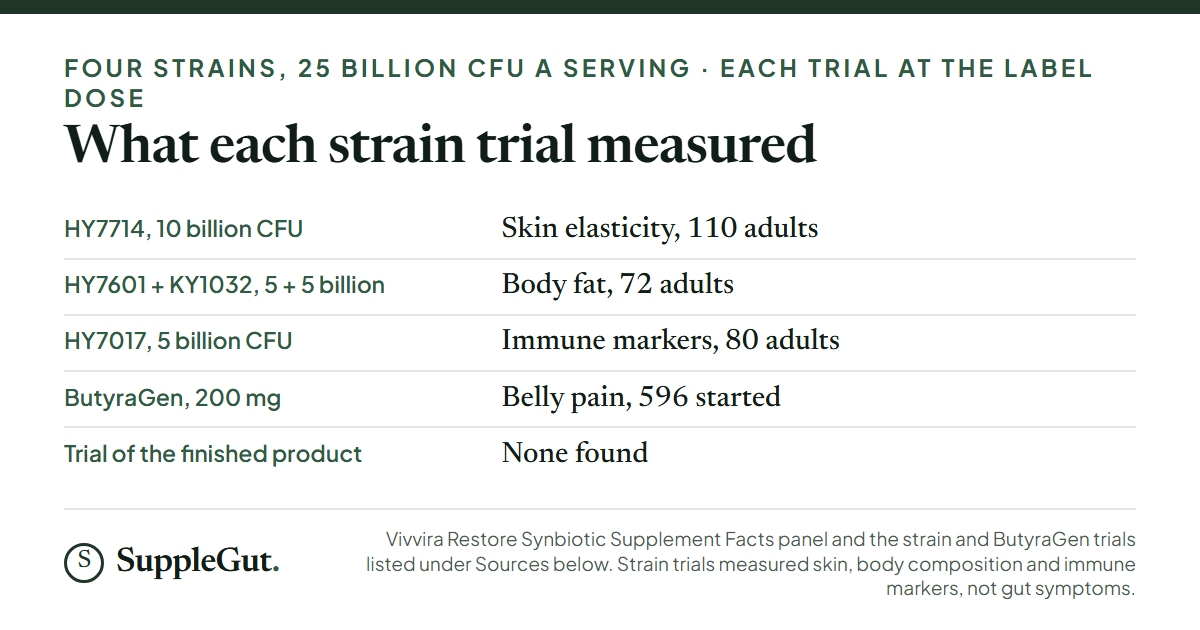
Does Vivvira Restore Synbiotic work? We could find no trial of the finished product. Its four strains (HY7714 at 10 billion CFU, HY7601 and KY1032 at 5 billion each, HY7017 at 5 billion) each have a trial at the label dose, but they measured skin, body fat and immune markers, not gut symptoms. The 200 mg ButyraGen tributyrin complex has a maker-funded online trial of 596 people that reported less belly pain than placebo, with no effect sizes in the abstract. The only rating is the brand’s own, 4.91 from 54 reviews, 36 flagged as rewarded.
Vivvira Restore Synbiotic is a two-capsule daily product with four named probiotic strains, 25 billion CFU in total, and a 200 mg tributyrin complex the brand calls a postbiotic generator. It is sold only on the brand’s own site. What sets it apart from most small-brand labels is the printing: every strain carries a code and its own CFU. This page sets out what the panel shows, what each strain’s trial measured, what the one gut-outcome trial of the tributyrin complex reported, how the reviews are built, and what the brand’s published price and refund terms say.
What Restore Synbiotic is, and what it is not
The Supplement Facts panel lists four probiotic strains, each with a weight and a count, and one branded ingredient. There is no proprietary blend. A serving is two capsules, taken together once a day, and a bottle holds 30 servings.
| Ingredient as printed | Weight | Count |
|---|---|---|
| Lactobacillus plantarum HY7714 | 50 mg | 10 billion CFU |
| Lactobacillus curvatus HY7601 | 25 mg | 5 billion CFU |
| Lactobacillus plantarum KY1032 | 25 mg | 5 billion CFU |
| Lacticaseibacillus paracasei HY7017 | 20 mg | 5 billion CFU |
| ButyraGen tributyrin complex (tributyrin 100 mg, partially hydrolyzed guar gum 20 mg) | 200 mg | not applicable |
The four strains add up to 25 billion CFU and 120 mg of strain powder, by our arithmetic. The other ingredients are a hypromellose capsule, rice fiber, rice fiber extract, acacia fiber, rosemary extract and microcrystalline cellulose, with no grams printed for the fibers. ButyraGen is a registered trademark of its maker, NutriScience Innovations, not of the brand. It is not a single-strain product, and it is not a fiber supplement: the only named prebiotic on the panel is the 20 mg of partially hydrolyzed guar gum inside the complex.
The brand’s page describes the capsules as delayed-release and designed to survive stomach acid. The label’s ingredient list names a plain hypromellose capsule and no coating, so the delayed-release claim has nothing printed beside it.
The trial of the product itself
There is none. A PubMed search under the product name returned only general synbiotic reviews, and ClinicalTrials.gov holds no study of it. The brand’s research page lists work on each ingredient, along with mouse and cell studies and a white paper from the complex’s maker, and none of it tests the four strains and the tributyrin together. The brand’s About page says every ingredient is “clinically dosed and backed by human research”, which is a brand claim. The sections below check it ingredient by ingredient.
The evidence for the four strains
Each strain has a trial at the label’s CFU dose, which the panel’s strain codes make possible to check. The outcomes are not gut outcomes.
HY7714 (10 billion CFU). In a randomized trial of 110 adults aged 41 to 59 with dry skin and wrinkles, 10 billion CFU a day for 12 weeks raised skin water content on the face and hands and reduced wrinkle depth, with skin elasticity 21.73% higher than in controls at week 12 (Lee et al., Journal of Microbiology and Biotechnology, 2015). A later study of the same strain, written by employees of the strain’s maker, found more Bifidobacterium and lower plasma markers linked to skin and gut permeability (Nam et al., PLoS One, 2020).
HY7601 with KY1032 (5 billion each). In 72 adults with overweight, 10 billion CFU of the two strains combined for 12 weeks lowered body weight, visceral fat mass and waist circumference against placebo, and raised Bifidobacteriaceae and Akkermansiaceae in stool (Mo et al., Nutrients, 2022). A 2026 trial in 100 overweight adults with mildly high triglycerides, 80 of whom finished, reported triglycerides falling from 158.61 to 139.54 mg/dL, with authors tied to the strain’s maker (Kim et al., Nutrients, 2026).
HY7017 (5 billion). In 80 adults suspected of reduced immune function, one capsule of 5 billion CFU a day for eight weeks raised natural killer cell activity and interferon gamma against control, with no clinically notable differences in adverse events (Journal of Medicinal Food, 2026).
Taken together, three trials match the label dose and measured skin, body composition and immune markers. None measured bloating, regularity or stool. The brand’s page does link the strains to those outcomes, under headings such as skin health, weight management and immune support, and it makes a gut claim of its own for the tributyrin complex.
The tributyrin complex and its trial
Tributyrin is three butyrate molecules attached to glycerol, and digestive enzymes release the butyrate along the gut, where cells lining the colon use it as fuel. The one trial with a gut outcome at the label dose is of the 200 mg complex. It was a randomized, double-blind, placebo-controlled study run online, with no in-person visit, and 596 people started it over six weeks. The abstract reports a statistically significant improvement in belly pain against placebo, particularly in women and especially post-menopausal women, and gives no effect sizes (Nutraceuticals, 2025). The complex’s maker funded it.
A second paper reports the mood analysis of the same group, run by Radicle Science. Of 596 enrolled, 229 on the complex and 218 on placebo completed, about 75%, with substantial early dropout and diet and exercise not controlled. It found lower anxiety in men and no overall benefit for self-reported depression (Nutrition and Dietary Supplements, 2025). An earlier pilot of 29 healthy adults at 200 or 400 mg for 28 days found the complex well tolerated, with two people reporting digestive discomfort (Nutrition and Healthy Aging, 2024). We could not read the full text of the belly pain trial, only its abstract.
The prebiotic fiber on the panel is 20 mg of partially hydrolyzed guar gum. The one trial of that fiber in IBS found support for 6 g a day in people with bloating, which is about 300 times the label amount by our arithmetic. The 20 mg sits inside the tributyrin complex as a component, not as a fiber dose.
The class-level evidence
A meta-analysis of 82 randomized trials in 10,332 adults with IBS rated the certainty of probiotic benefit for global symptoms as low for Lactobacillus strains and very low for combination products, found only 24 trials at low risk of bias, and made no strain-specific recommendation (Goodoory et al., Gastroenterology, 2023). A 12-week trial in 120 adults with IBS tested microencapsulated sodium butyrate with five probiotic strains and a short-chain fiber. More people reported adequate relief at four weeks, fewer reported worsening at 12 weeks (5.9% against 16.0%), and symptom severity scores did not differ; the maker of the butyrate ingredient funded it (Gasiorowska et al., Journal of Clinical Medicine, 2024). That used sodium butyrate and a different strain set, so it bears on the idea, not on this formula.
How to take it
The label says to take two capsules at once, daily, at any time that suits the routine, with or without food, and that no refrigeration is needed. The brand’s expectations page describes possible mild bloating and gas in weeks one and two, better regularity and digestion in weeks two to four, and skin, metabolic and immune effects over months two to four. Those timings are the brand’s, not trial results. Strain trials ran for 8 to 12 weeks and the belly pain trial for six, so a fair test is at least a month.
Side effects and who should not take it
The label reads: if you are pregnant, nursing, taking medication, or have a medical condition, consult your healthcare professional before use, and do not use if the seal is broken. The brand’s FAQ says to consult a healthcare provider first in pregnancy and, for under 18, to consult a pediatrician for age-appropriate probiotics. None of the 54 reviews on the brand’s page describes gas, cramping or loose stools as a problem, though that is weak evidence given where the reviews sit. The label prints no allergen or free-from statement. The page badges say gluten free and non-GMO, and the testing section lists major allergens as tested for without saying the capsule is free of them. Our general guide to probiotic side effects covers the usual first-week effects.
What the reviews say
The only rating from any source is the brand’s own: 4.91 from 54 reviews on its product page (52 five-star, one three-star, one two-star). The feed flags 36 of the 54 as rewarded, meaning the reviewer received an incentive. Those average 4.94 against 4.83 for the 18 not flagged. Many reviewers mention a coach or creator, and several describe spring pre-orders, so the reviewers include people with a link to the brand’s launch. There is no Amazon listing, no Trustpilot profile and no BBB entry to read, and Reddit could not be read for this page.
The recurring praise is less bloating (25 of the 54 mention it), clearer skin (16 mention skin or acne), and no nausea even on an empty stomach. The complaints are short: one verified two-star reviewer saw no change, a three-star reviewer noticed nothing at first and later wrote a five-star review, and one reviewer asked to buy the refill pouches without a subscription.
Price, subscription and refund terms
| Route | Price for 30 servings | Per day |
|---|---|---|
| One-time purchase, no free shipping | $60.00 | $2.00 |
| Monthly delivery, “Subscribe and save 10%”, free shipping | $54.00 | $1.80 |
The brand’s FAQ mentions a 90-day supply with quarterly deliveries, but the product page offers only the two routes above and we found no 90-day option. The first shipment includes a glass jar, and later shipments come as refill pouches. The refund policy states a 30-day money-back guarantee on the first 30-day bottle only, with shipping, VAT and duties deducted and no return needed. If several bottles are ordered, it covers the first and the brand will help arrange returns of unopened ones. For a subscription, the guarantee covers the first shipment; after that the subscription can be canceled at any time in the customer portal. We found no billing or cancellation complaints, but with no independent review platform that is an absence of data, not evidence either way.
Who Restore Synbiotic is for
- Someone who wants every strain named with its own CFU and is comfortable that the strain trials measured skin, weight and immune markers.
- Someone interested in a tributyrin complex at the 200 mg dose its one gut trial used, aware that its maker funded that trial.
- Someone who will take two capsules daily for at least a month and will use the 30-day window on the first bottle.
For a multi-strain capsule with a trial of its own finished formula, see Seed DS-01 and the DS-01 guide. Ritual Synbiotic+ is another synbiotic capsule; one Restore Synbiotic reviewer says they switched from it. For a separate tributyrin product, see Peak Performance CoreBiome Tributyrin. To see how CFU counts relate to trial doses, read how many CFU you need, and the probiotic chooser and the quiz start from symptoms.
The products in this catalog
Common questions
Does Vivvira Restore Synbiotic work?
No trial of the finished product was found. Each strain has a trial at the label’s CFU dose, but the outcomes were skin elasticity, weight and visceral fat, and immune markers, not bloating. The 200 mg tributyrin complex has a six-week, 596-person online trial that reported less belly pain than placebo, funded by its maker, with no effect sizes in the abstract. Reviewers on the brand’s page, 36 of 54 flagged as rewarded, mostly describe less bloating and clearer skin.
What strains are in Vivvira Restore Synbiotic?
The panel prints four: Lactobacillus plantarum HY7714 (10 billion CFU), Lactobacillus curvatus HY7601 (5 billion), Lactobacillus plantarum KY1032 (5 billion) and Lacticaseibacillus paracasei HY7017 (5 billion), 25 billion CFU a serving. It also lists 200 mg of ButyraGen tributyrin complex, made of tributyrin 100 mg and partially hydrolyzed guar gum 20 mg.
What is ButyraGen, and does tributyrin help with bloating?
ButyraGen is a branded tributyrin complex made by NutriScience Innovations, which also funded its belly pain trial. Tributyrin is a form of butyrate that digestive enzymes release along the gut. The 596-person online trial reported less belly pain than placebo over six weeks, particularly in women. It measured pain, and the abstract gives no figures, so we found no trial result for bloating.
Does Vivvira have side effects, and is it safe?
The label says to consult a healthcare professional if pregnant, nursing, taking medication or with a medical condition, and not to use it if the seal is broken. The brand’s FAQ says some people notice mild bloating and gas in the first two weeks. None of the 54 reviews on the brand’s page reports a gut side effect, which is weak evidence because 36 of the 54 are flagged as rewarded.
How much does Vivvira cost?
A 30-day bottle is $60 as a one-time purchase ($2.00 a day, no free shipping) or $54 with a monthly subscription ($1.80 a day, free shipping). It is sold only on the brand’s site; the first shipment comes with a glass jar and later ones as refill pouches, which one reviewer says cannot be bought without a subscription.
Can you cancel Vivvira or get a refund?
The brand states a 30-day money-back guarantee on the first 30-day bottle only, less shipping, with no return needed, and says a subscription can be canceled at any time in the customer portal. No billing or cancellation complaints turned up, but there is no Trustpilot or BBB profile to check, so that is an absence of data.
How reliable are the Vivvira reviews?
The 4.91 from 54 reviews is on the brand’s own page, and the feed flags 36 as rewarded. No Amazon listing, Trustpilot profile or BBB entry exists, so no independent rating could be read. The rewarded reviews average 4.94 and the other 18 average 4.83.
Sources
- Lee DE, et al. Lactobacillus plantarum HY7714 and skin aging: randomized trial in 110 adults. Journal of Microbiology and Biotechnology, 2015. PMID 26428734
- Nam B, et al. Lactobacillus plantarum HY7714 and gut condition. PLoS One, 2020. PMID 32275691
- Mo SJ, et al. Lactobacillus curvatus HY7601 and Lactobacillus plantarum KY1032 in overweight adults: randomized trial of 72. Nutrients, 2022. PMID 35745214
- Kim EJ, et al. HY7601 and KY1032 and triglycerides in overweight adults. Nutrients, 2026. PMID 42280356
- Lacticaseibacillus paracasei HY7017 and immune function: randomized trial of 80 adults. Journal of Medicinal Food, 2026. doi.org/10.1177/1096620X251384553
- ButyraGen tributyrin complex, online randomized trial of belly pain. Nutraceuticals, 2025. doi.org/10.3390/nutraceuticals5020014
- ButyraGen and the gut-brain axis: randomized trial, mood analysis. Nutrition and Dietary Supplements, 2025. doi.org/10.2147/NDS.S565532
- ButyraGen pilot study in healthy adults. Nutrition and Healthy Aging, 2024. doi.org/10.3233/nha-240005
- Goodoory VC, et al. Probiotics in irritable bowel syndrome: systematic review and meta-analysis of 82 randomized trials. Gastroenterology, 2023. PMID 37541528
- Gasiorowska A, et al. Microencapsulated sodium butyrate with probiotics and short-chain fiber in IBS. Journal of Clinical Medicine, 2024. PMID 39797089
- Partially hydrolyzed guar gum in IBS patients, 121 randomized. Nutrition & Metabolism, 2016. PMID 26855665
- Brand pages: label, directions, price and reviews vivvira.com/products/restore-synbiotic; research vivvira.com/pages/research; refund policy vivvira.com/policies/refund-policy
Not sure which product fits your situation?
This guide covers the mechanics. The quiz takes your specific symptoms, routine and preferences and matches you to one product from the catalog.
Take the quiz →