Guide
Does Optimal 1 Digest-A-Meal work? Two blends, one activity figure, and a rating that is 98.7% imported
Quick answer
Does Optimal 1 Digest-A-Meal work? We found no trial of the formula. Two placebo-controlled trials of other multi-enzyme supplements in functional dyspepsia (120 adults on 400 mg a day for two months, and 40 patients on 150 mg a day for 60 days) improved symptom scores, but this label gives its enzyme blend as one 150 mg total with a single activity figure, and its seven probiotic organisms as one 50 million CFU total. The brand's review widget shows 4.65 from 151 reviews, 149 of them imported from another provider and 86 dated 2021.
Optimal 1 Digest-A-Meal is a capsule from Optimal Health Systems that puts plant enzymes, aloe vera leaf powder and a seven-organism probiotic mix into one product, taken before meals. The brand calls it its top-selling digestive aid of more than 20 years, and many reviewers know it by its older name, Optimal 1 Digestion. This page reads the panel line by line, sets the enzyme and probiotic numbers beside the trials, and looks at the brand’s stronger claims and the review record.
Two capsules, two blends
The Supplement Facts panel sets a serving at two capsules, with 45 servings in a 90-capsule bottle. Per serving it prints:
- A “Proprietary Plant Enzyme Blend” of 150 mg. Inside it, only dipeptidyl peptidase IV (DPP-IV) has an activity figure, 125,000 AU. Proteases, amylases, lactase, alpha-galactosidase, bromelain, papain, lipase and cellulase are named with no amounts.
- Three enzymes with their own amounts: amylase 50 mg (4,250 DU), invertase 1 mg (170 SU) and maltase 1 mg (21.25 DP).
- Aloe vera leaf, 50 mg.
- A “Patented Stabilized Heat Resistant Probiotics” mix of 10 mg and 50 million CFU, naming seven organisms with no per-organism counts. The only strain designation is Lactobacillus acidophilus DDS-1; the others are L. bulgaricus, Bifidobacterium bifidum, L. salivarius, Lactococcus lactis, Streptococcus thermophilus and B. lactis.
The other ingredients are rice flour, rice hulls, a vegetable capsule and plant-based magnesium stearate. The Daily Value column is marked as not established throughout. The page carries badges for dairy-free, gluten-free, vegetarian and non-GMO, and has no “contains” line or facility statement, so egg, soy, tree nut, fish and sesame are not addressed. L. bulgaricus and S. thermophilus are dairy-culture organisms, and the page does not say what they were grown on.
The brand also shows a TruShield badge, which it describes as a screen for more than 400 banned substances by a laboratory with WADA experience. That is a banned-substance screen, and no lab report for enzyme activity or CFU was found. The brand says the product is made in a GMP facility and that the formula was changed in 2019, the first change in 20 years.
Has the formula itself been studied?
A PubMed search for the company returned only unrelated articles, and the brand’s page cites no study of the capsule. The research that exists concerns other enzyme products, one of the seven probiotic strains, and aloe in general.
For the enzymes, the nearest evidence is two placebo-controlled trials of multi-enzyme supplements in functional dyspepsia:
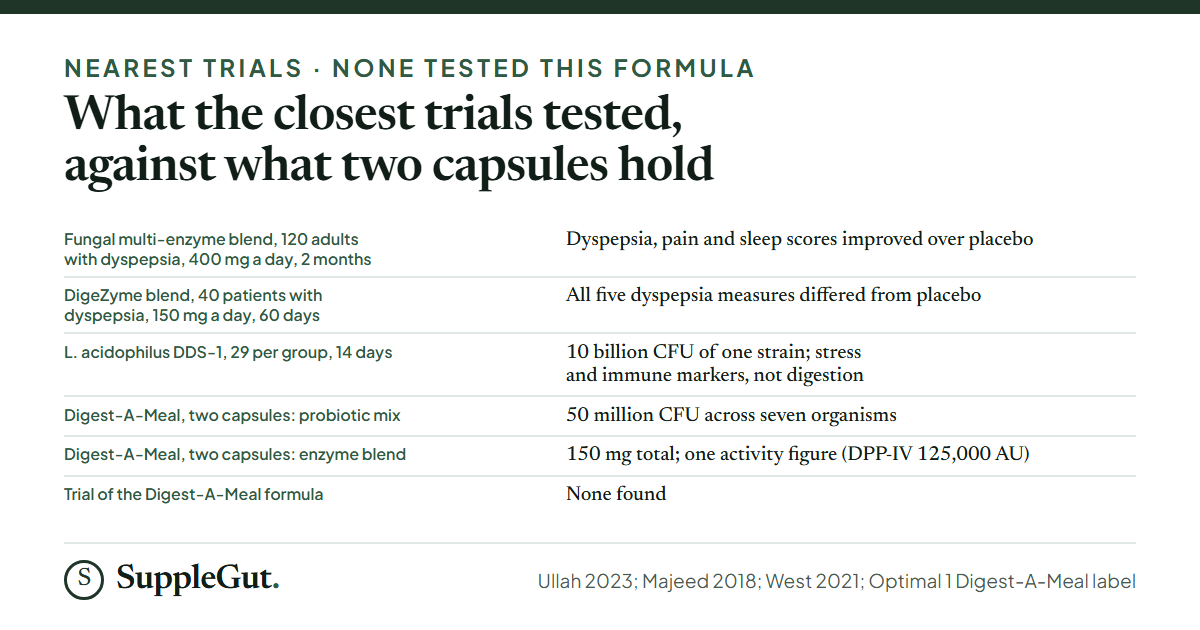
- 120 adults aged 18 to 59 took 2 capsules a day of a fungal-fermentation multi-enzyme blend, 200 mg per capsule and 400 mg a day, or placebo, for two months. Scores on the Nepean Dyspepsia Index, a pain scale and a sleep questionnaire improved on the enzymes, and no side effects were reported (Ullah et al., Biomedicine & Pharmacotherapy, 2023).
- 40 patients took the DigeZyme multienzyme complex at 50 mg three times a day, 150 mg in all, or placebo for 60 days. All five dyspepsia measures differed from placebo (P from .0401 to .0033), and no product-related adverse events were reported. The authors work for the supplier (Majeed et al., Journal of Medicinal Food, 2018).
Both used a specified blend at a stated daily weight. Digest-A-Meal’s listed enzyme weights add up to 202 mg per two-capsule serving (150 + 50 + 1 + 1), which is 303 to 606 mg across the 3 to 6 capsules the brand directs on a three-meal day. Milligrams of different enzyme blends are not interchangeable, though, and this blend’s makeup is mostly unquantified, with one activity figure, so the label cannot be set against either trial. Both trials enrolled people with functional dyspepsia; neither tested heartburn, gluten, dairy sugar or the brand’s other stated uses. The same two trials appear in the ElevenZyme guide, and the digestive enzymes guide covers where single-purpose enzymes have support.
The probiotic mix against a trial dose
The one strain with a designation, L. acidophilus DDS-1, has a randomized trial: night-shift workers took 10 billion CFU of DDS-1 (or of a B. lactis strain, or placebo), 29 per group, for 14 days. Serum markers of stress and immune activity shifted less in the probiotic groups before the first night shift, and there were no significant group-by-time effects after the shifts. The outcomes were cortisol, pentraxin and similar markers, not digestive symptoms (West et al., Frontiers in Immunology, 2021).
Digest-A-Meal’s two capsules give 50 million CFU across all seven organisms, one two-hundredth of the DDS-1 trial dose, with DDS-1 only one of the seven and no per-organism count printed. On a three-meal day at 3 to 6 capsules, the total is 75 to 150 million CFU. We found no trial of this seven-organism mix. What a CFU count does and does not predict is in the CFU guide.
The aloe leaf line, and what the page says about it
The panel lists aloe vera leaf at 50 mg, noted as naturally containing copper, zinc and manganese. No aloe latex, aloin or anthraquinone figure appears on the panel or the page, and the label has no senna, cascara or rhubarb. The page lists reduced constipation among aloe’s properties and says aloe “provides antioxidant and antibacterial properties.” An FAQ also says the enzymes help with eliminating gas and harmful bacteria. These are the brand’s statements. The panel does not say whether the leaf powder has the latex removed, and the page gives no aloin limit.
Aloe has been studied in irritable bowel syndrome. A meta-analysis of three randomized trials in 151 people found improved symptom scores (standardized mean difference 0.41, 95% CI 0.07 to 0.75) and response rates (risk ratio 1.69, 1.05 to 2.73) against placebo, with no aloe-related adverse events (Hong et al., Journal of Neurogastroenterology and Motility, 2018). The preparations and doses in those trials were not checked against a 50 mg leaf powder for this page, and two of the trials a search returned were of an extract rather than leaf powder.
Antacids, babies and pregnancy: the brand’s claims
The product page’s FAQ goes further than the panel. It answers yes to whether Digest-A-Meal can replace antacids and acid blockers, says some mothers have put it in their infants’ formula, calls it perfectly okay in pregnancy and breastfeeding, and answers no to whether a person can overdose. The long-form text links poor digestion to arthritis, gout, diabetes and heart disease. The brand says plant enzymes break food down and that the probiotics and aloe help absorption.
Those are statements on the brand’s page. No warning text about pregnancy, medications or age appears on the panel image or the page beyond the standard FDA disclaimer, and the jar’s own warnings could not be read in any photo. The trials above did not test replacing acid-lowering medicine or use in infants. For heartburn on its own terms, the acid reflux guide sets out what has trial support.
How to take it, and side effects
The page directs 1 to 2 capsules before each meal or as needed. It says a missed dose can be taken after the meal, and that capsules can be opened onto food. The panel’s serving is two capsules, so a person taking one capsule before three meals takes 1.5 servings a day, and two capsules before three meals takes three. The brand states it is heat resistant and needs no refrigeration.
The trials of other enzyme blends above reported no product-related side effects. In the Digest-A-Meal reviews, a few people describe stomach pain or upset, including one who stopped taking it, and a few report no effect. The usual effects of probiotic organisms and when to stop are in the probiotic side effects guide.
What the reviews say, and how they were collected
The brand’s page runs a Judge.me review app showing 4.65 out of 5 from 151 reviews: 121 five-star, 18 four-star, 4 three-star, 5 two-star and 3 one-star. Judge.me’s public endpoint returns the same average and count. How the 151 were gathered shapes what that number means:
- 149 of the 151 are labeled “review collected from another provider,” meaning imported. Only 2 were collected through the store, both in 2026, and those 2 are flagged as verified buyers.
- By year, 86 are from 2021, 50 from 2022 and 13 from 2023, with none from 2024 or 2025.
- Several imported star ratings contradict their text. Examples include one-star and two-star ratings attached to praise such as “love this product,” and five-star ratings attached to text describing stomach pain or no benefit. The average may not match what those reviewers meant, and we could not resolve it.
The text itself leans positive. Reviewers praise less bloating, gas, reflux and indigestion, use over 20 or 25 years, and more regular bowel movements for some. The complaints are no effect, stomach pain in a few, and shipping cost and the return window; one reviewer reported $17.95 to ship a single bottle to Honolulu in 2023.
Outside the brand’s page there is little to read. Both Amazon listings, the standard bottle and a family-size one, read as currently unavailable with no price or rating shown. The Trustpilot profile is unclaimed and shows one review. We did not find a listing at Walmart or Target. The brand’s page also shows a typed 4.9 “Excellent” graphic on a product image, which is not a review widget.
Price per serving and per day, autoship and shipping
| Route | Price | Per serving | Per day |
|---|---|---|---|
| One bottle, one time | $36.00 | $0.80 (2 capsules) | $1.20 to $2.40 |
| One bottle, 1-, 2- or 3-month autoship (10% off) | about $32.40 | about $0.72 | about $1.08 to $2.16 |
The per-day range assumes 1 to 2 capsules before each of three meals. The autoship figure is 10% off the one-time price; the discounted amount itself does not show on the static page. The brand says its HSA/FSA eligibility applies to one-time purchases only, not autoship. We could not tell from the page whether autoship is pre-selected, because the widget loads by script, and we found no written subscription or cancellation terms beyond the refund policy. Shipping was not read for a full order. Wholesale pricing is offered to practitioners behind a login, and a $1 pouch offer is listed separately at $34.00.
Refund terms in the brand’s policy
The refund policy has two windows. Opened bottles with at least half the product remaining can be returned within 30 days of purchase for the product price, not the handling and shipping fees. Unopened bottles can be returned within 90 days, and there are no refunds of any kind after 90 days. Empty bottles or containers are not processed. The customer pays return shipping unless the brand is at fault, and refunds arrive within 10 business days of a return being approved. The product page shows a “30 Day Money Back Guarantee” with an asterisk. One reviewer wrote that 30 days for opened bottles is too short to return for full credit.
Who Digest-A-Meal suits
- Someone who wants enzymes, a probiotic and aloe in one capsule and accepts that the amounts inside the two blends are not printed.
- Someone taking enzymes with each meal, who will use 3 to 6 capsules a day and prices it at $1.20 to $2.40.
- Someone comfortable with a review record that is mostly imported and mostly from 2021 to 2023.
For enzyme-only capsules, Zenwise, Digest Gold and DFH DigestZymes are in the catalog below. The enzymes against probiotics guide compares the two approaches, and the quiz starts from symptoms.
The products in this catalog
Common questions
Is there any evidence that Optimal 1 Digest-A-Meal helps digestion?
Nothing tested the formula itself, and the brand's page cites no study. Other multi-enzyme supplements improved dyspepsia scores in two placebo-controlled trials of 120 adults and 40 patients, at defined daily doses of 400 mg and 150 mg. This label lists a 150 mg enzyme blend with only one activity figure, so it cannot be matched to either.
What does one serving of Digest-A-Meal contain?
Two capsules hold a 150 mg plant enzyme blend (dipeptidyl peptidase IV at 125,000 AU, plus proteases, amylases, lactase, alpha-galactosidase, bromelain, papain, lipase and cellulase with no separate amounts), amylase 50 mg, invertase 1 mg, maltase 1 mg, aloe vera leaf 50 mg, and a 10 mg mix of seven probiotic organisms totaling 50 million CFU. Other ingredients are rice flour, rice hulls, a vegetable capsule and plant-based magnesium stearate.
How many capsules a day does the brand direct, and what does that cost?
The brand says to take 1 to 2 capsules before each meal or as needed, which is 3 to 6 capsules on a three-meal day. A 90-capsule bottle is $36.00, or $0.80 per two-capsule serving, so a day costs $1.20 to $2.40. Autoship takes 10% off, and shipping is charged separately.
Does the aloe in Digest-A-Meal act as a laxative?
The label lists aloe vera leaf at 50 mg and no senna, cascara or rhubarb. The product page says aloe reduces constipation, and it does not say whether the leaf powder has its latex removed or give an aloin figure. We found no trial of this amount of aloe leaf; a meta-analysis of three aloe trials in 151 people with IBS used other preparations.
Can Digest-A-Meal replace an antacid, or be given to babies?
The brand's FAQ answers yes to replacing antacids and acid blockers, says some mothers have put it in infant formula, and calls it okay in pregnancy and breastfeeding. Those are the brand's statements. The panel and page carry no warning text, and none of the trials above tested these uses.
Why is the 4.65 rating for Digest-A-Meal hard to read?
It comes from a review app on the brand's own page, and 149 of the 151 reviews are labeled as collected from another provider. 86 are dated 2021, none 2024 or 2025, and some imported star ratings contradict their text. Both Amazon listings read as unavailable, and the Trustpilot profile is unclaimed with one review.
What are the return terms for Digest-A-Meal?
Opened bottles with at least half remaining can be returned within 30 days for the product price, not shipping or handling. Unopened bottles can be returned within 90 days, and there are no refunds after that. Empty containers are not accepted, the buyer pays return shipping unless the brand is at fault, and refunds follow within 10 business days of approval.
Does Digest-A-Meal need refrigeration?
The brand describes its probiotics as heat resistant and says the product does not have to be refrigerated. The label gives one CFU total of 50 million for seven organisms, with only Lactobacillus acidophilus DDS-1 carrying a strain designation.
Sources
- Ullah H, Di Minno A, Piccinocchi R, et al. “Efficacy of digestive enzyme supplementation in functional dyspepsia: a monocentric, randomized, double-blind, placebo-controlled, clinical trial.” Biomedicine & Pharmacotherapy, 2023;169:115858. PubMed 37976892
- Majeed M, Majeed S, Nagabhushanam K, et al. “Evaluation of the safety and efficacy of a multienzyme complex in patients with functional dyspepsia: a randomized, double-blind, placebo-controlled study.” Journal of Medicinal Food, 2018;21(11):1120–1128. PubMed 30156436
- West NP, Hughes L, Ramsey R, et al. “Probiotics, anticipation stress, and the acute immune response to night shift.” Frontiers in Immunology, 2021;11:599547. PubMed 33584665
- Hong SW, Chun J, Park S, et al. Aloe vera in short-term treatment of irritable bowel syndrome: a systematic review and meta-analysis. Journal of Neurogastroenterology and Motility, 2018;24(4):528–535. PubMed 30153721
- Optimal Health Systems: product page, Supplement Facts panel image, FAQ, selling plans and price. optimalhealthsystems.com
- Optimal Health Systems refund policy. optimalhealthsystems.com/policies/refund-policy
- Judge.me review widget for the product (average, count, histogram, dates and import labels). Read through the brand’s page and Judge.me’s public endpoint.
- Amazon listings for Optimal 1 Digest-A-Meal (ASIN B0HL4CTVH3) and the Family Size version (ASIN B0HL4DP31T): availability. amazon.com
- Trustpilot profile for optimalhealthsystems.com. trustpilot.com
Still deciding between products?
The guide gives the background. For a single answer, the quiz asks about your symptoms, your routine and what you have tried, then names one product.
Take the quiz →