Guide
Does Seneca work? Seven named strains, butyrate and berberine, and no trial of the capsule
Quick answer
Does Seneca work? No trial of Seneca itself was found. Its lead strain, B. lactis HN019, sped gut transit in a two-week trial of 100 adults but did no better than placebo in two later constipation trials, and its berberine is 150 mg against 400 mg a day in the IBS-D trial. The brand’s own review app shows 2.9 out of 5 from 7 reviews, though the page header reads 5.0.
Seneca is a two-capsule daily supplement from Enclave BioActives, the company behind Emma, advertised through video pages fronted by a New York gastroenterologist for regularity, bloating and “microbiome restoration.” Where most probiotics stop at bacteria, it adds sodium butyrate, the fatty acid that feeds the cells lining the colon, plus berberine and aloe gel. This page sets out the label, the trials behind each ingredient and their doses, the reviews, and the refund terms.
What two Seneca capsules contain
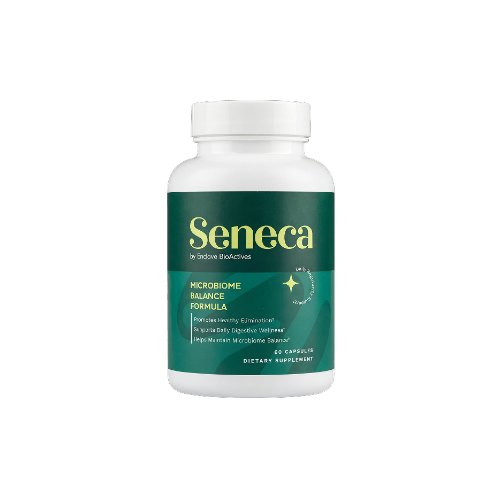
The bottle reads “Microbiome Balance Formula,” 60 capsules, and the Supplement Facts panel sets a serving at two capsules, 30 servings a bottle:
| Ingredient as printed | Per serving |
|---|---|
| Sodium butyrate | 350 mg |
| Berberine hydrochloride (Phellodendron amurense bark) | 150 mg |
| Probiotic blend, 20.5 billion CFU at manufacture | 102.5 mg |
| L-glutamine | 75 mg |
| Aloe vera gel extract (leaf) | 50 mg |
| Vitamin D3 | 50 mcg (250% DV) |
| Aged garlic extract | 250 mcg |
The blend names seven strains, each with its code: B. lactis HN019 (55%); L. plantarum CCFM8610, L. plantarum CCFM8724 and L. rhamnosus GG (10% each); and L. plantarum 299v, Bacillus coagulans CCFM1041 and Saccharomyces boulardii HS5 (5% each). The label does not say whether those shares are by count or by weight, so no strain’s live count is printed, and the 20.5 billion is guaranteed only “at time of manufacture.” The vitamin D is 2,000 IU, half the 100 mcg daily upper limit for adults. The aloe is printed as gel extract, and the brand says it uses the inner gel, not the outer latex. There is no sweetener and no allergen statement.
No trial has tested the Seneca capsule
A PubMed search for Seneca with its ingredients returned nothing, and we found no study of HN019, butyrate and berberine together. The brand calls Seneca “a clinical grade gut restoration system,” its own description, and says it was developed with Gina Sam, MD, in whose voice the sales FAQ is written. The Seneca pages do not describe her financial tie to the company; its Emma page says she is a paid member of the Enclave BioActives medical advisory board.
What each Seneca ingredient has behind it
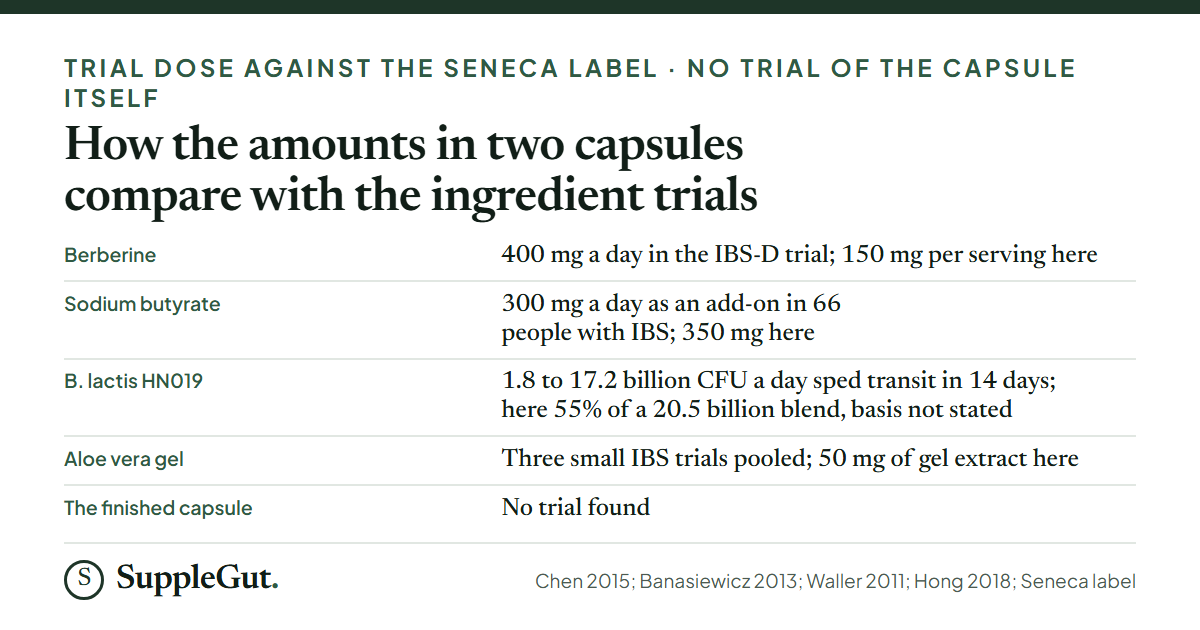
B. lactis HN019, the largest share. In 100 adults with functional gut symptoms, 14 days of HN019 shortened whole-gut transit from 49 to 21 hours at 17.2 billion CFU a day and from 60 to 41 hours at 1.8 billion, against 43 to 44 hours on placebo (Waller et al., 2011). Two larger trials in diagnosed functional constipation did not repeat it: 228 adults on 1 or 10 billion CFU for 28 days showed no difference from placebo in transit or symptoms, apart from more bowel movements in a subgroup with three or fewer a week (Ibarra et al., 2018), and an eight-week trial that enrolled 224 found HN019 no better than placebo on complete bowel movements (Ala-Jaakkola et al., 2025). Both later trials were led by researchers at the strain’s commercial owner.
The other six strains. L. plantarum 299v eased IBS pain against placebo in a four-week trial of 214 patients at a dose reported as 10 billion CFU a day (Ducrotté et al., 2012); it is 5% of Seneca’s blend. The two CCFM plantarum strains have human trials in eczema, blood cadmium and children’s teeth, not gut symptoms, and we found no study under the CCFM1041 or HS5 codes. The brand calls the blend a “Butyrogen Complex” of butyrate-producing strains, but none of the seven belongs to the gut bacteria known for making butyrate, such as Faecalibacterium and Roseburia; bifidobacteria raise butyrate indirectly by feeding them (Rivière et al., 2016).
Sodium butyrate, 350 mg. In 66 people with IBS already on standard treatment, adding microencapsulated sodium butyrate made pain during bowel movements less frequent by four weeks and improved urgency and bowel habit by twelve, but did not significantly reduce how severe the symptoms were (Banasiewicz et al., 2013). The dose was 300 mg a day (Załęski et al., 2013), close to Seneca’s 350 mg, which the product page, though not the panel, calls microencapsulated.
Berberine, 150 mg. In 132 people with diarrhea-predominant IBS, 400 mg of berberine hydrochloride a day for eight weeks reduced diarrhea, abdominal pain and urgency more than placebo (Chen et al., 2015). Two Seneca capsules hold 150 mg, under two-fifths of that dose.
Aloe vera gel, 50 mg. A pooled analysis of three small IBS trials, 151 patients in all, found a modest benefit over placebo, a standardized mean difference of 0.41 (Hong et al., 2018).
Read together: the strain with the most data has mixed results and an unclear dose in this bottle, the butyrate matches one small add-on trial, and the berberine is below its trial dose. None of it was tested as Seneca’s combination.
Taking Seneca, and for how long
The company’s store gives the directions as two capsules a day with water, preferably before a meal. The sales FAQ suggests three to four months and says some people notice a change within hours; no trial of the product measured either. The ingredient trials above ran from 14 days to 12 weeks.
Seneca side effects, and who should ask a doctor first
The FAQ on the company’s store asks anyone with a medical condition, on medications or other supplements, pregnant or nursing to consult a healthcare provider before use. No warning text appears with the panel on the brand pages. Memorial Sloan Kettering advises against berberine in pregnancy and breastfeeding, notes it can raise blood levels of cyclosporin and tacrolimus and slow the CYP2D6, 2C9 and 3A4 enzymes that clear many medicines, and lists upset stomach, diarrhea, constipation and rash as side effects (MSKCC). Among the seven reviews on the brand’s feed, one says “It made me sick” and another reports constipation returning after six good weeks.
The weight question in Seneca’s FAQ
The sales pages answer “Will Seneca help me lose weight?” by saying it is not a diet pill but that customers notice a flatter belly, fewer cravings and weight moving toward “a healthier set point.” The company’s own store answers: “Seneca is not formulated as a weight-loss or fat-burning supplement.” No trial of Seneca measured weight.
Seneca reviews and complaints, platform by platform
The product page on tryseneca.com shows five stars and “5.0/5.0” in its header, a figure typed into the page design. The review app on the same page, Loox, reads 2.9 out of 5 from 7 reviews: one five-star, two four-star, one three-star, one two-star and two one-star, all marked verified. The praise is relief after other products had failed and a quieter stomach; the complaints are no effect, feeling sick and relapse. The company’s own store shows a separate 5.0 from 2.
There is no Trustpilot profile for Seneca. The profile for Enclave BioActives, covering all its products, reads 2.9 from 70, with 56% one-star reviews, recent ones describing bottles or charges people say they did not order. The Better Business Bureau rates Enclave, LLC a B, with 23 complaints in three years. Amazon listings that use the Seneca name come from other sellers the brand says are not authorized, so their ratings are not counted here.
Seneca’s 90-day refund, the packs and the subscription
The refund policy runs 90 days from purchase. A single bottle can be refunded without returning it, once per product per year. On multipacks, the refund covers the first used bottle and any unopened bottles sent back, not later opened bottles, less 10% for shipping and handling where it applies. Orders cannot be cancelled once placed, and the company may offer a travel or event certificate instead of a refund, which the customer can decline.
On tryseneca.com, Seneca is sold one time only, in packs of one, three or six bottles. The company’s store opens with Subscribe & Save selected and the six-bottle plan checked, at $198.90 every six months. Its terms say subscriptions are cancelled by email, with a refund only if the order has not shipped.
| Purchase route | Price | Per day |
|---|---|---|
| 1 bottle, one time | $59.00 | $1.97 |
| 3 bottles, one time | $147.00 | $1.63 |
| 6 bottles, one time | $234.00 | $1.30 |
| 6 bottles, subscription every 6 months (15% off) | $198.90 | $1.11 |
The video sales pages add a $4.95 shipping fee to a single bottle and show struck-through prices of $99, $297 and $594 beside the packs.
Seneca and Emma, two formulas from one company
Emma, Enclave’s older gut capsule, is a botanical and vitamin formula: 200 mg of berberine with resveratrol, quercetin, star anise, licorice, inulin, B vitamins, vitamin D, magnesium and zinc, and no probiotics. Seneca swaps most of that for seven probiotic strains, sodium butyrate, aloe gel and 150 mg of berberine. Neither has a trial of its own, and only Emma is sold on Amazon and at Target. The Emma guide sets out its label and reviews.
Who Seneca suits
- Someone who wants probiotics and butyrate in one capsule and accepts that the combination has no trial.
- Someone not pregnant or breastfeeding, and not on medicines the berberine could affect without a doctor’s check.
- Someone who starts with one bottle, since the single-bottle refund needs no return.
For butyrate on its own, BodyBio Butyrate Sodium uses the same salt as the IBS trial. Choosing a probiotic by strain and dose is covered in which probiotic to take and how many CFU you need.
The products in this catalog
Questions people ask about Seneca
What are the complaints about the Seneca gut health supplement?
On the brand’s own Loox feed, Seneca has 2.9 out of 5 from 7 reviews: two say it made no difference or was not for them, and one says “It made me sick.” Complaints about the company as a whole include billing: its Trustpilot profile, which covers all its products, is 2.9 from 70, with 56% one-star reviews describing extra bottles or charges people say they did not order. The Better Business Bureau rates Enclave, LLC a B with 23 complaints in three years.
What ingredients are in Seneca?
Two capsules hold sodium butyrate 350 mg, berberine hydrochloride 150 mg, a 102.5 mg probiotic blend of seven named strains (20.5 billion CFU at manufacture), aloe vera gel extract 50 mg, L-glutamine 75 mg, vitamin D3 50 mcg and aged garlic extract 250 mcg. The blend lists B. lactis HN019 at 55% and the six other strains at 5% or 10% each. The rest is the capsule, brown rice flour, microcrystalline cellulose, stearic acid and calcium silicate.
Who makes Seneca, and what is Dr. Gina Sam’s role?
Seneca is made for Enclave BioActives, one of a group of companies trading as Konscious Brands from San Juan, Puerto Rico, with a Columbus, Ohio address on the label. The brand says it was developed with Gina Sam, MD, a New York gastroenterologist who presents its video sales pages. The Seneca pages do not describe her financial tie; the company’s Emma page says she is a paid member of its medical advisory board.
Can you buy Seneca on Amazon?
The brand says Seneca is sold only on its own websites and that Seneca sold anywhere else is not authorized. Amazon does list capsules under names such as Seneca Advanced and Seneca Supplement, from sellers that do not name Enclave, and one lists zinc carnosine, which the Enclave label does not contain. Their star ratings are not reviews of the brand’s product.
Does Seneca help with weight loss?
The FAQ on the brand’s sales pages says customers notice a flatter belly and that weight can move toward a healthier set point, while the FAQ on the company’s own store says Seneca is not formulated as a weight-loss or fat-burning supplement. No trial of Seneca measured weight.
How does Seneca’s 90-day refund work?
The policy gives 90 days from purchase. A single bottle can be refunded without sending it back, but only once per product per year; with multipacks, only the first used bottle and any unopened bottles you return are refunded, with 10% for shipping and handling deducted where it applies. Orders cannot be cancelled once placed.
How is Seneca different from Emma?
Both come from Enclave BioActives and both contain berberine. Emma is a botanical and vitamin capsule with 200 mg of berberine and no probiotics; Seneca pairs 150 mg of berberine with seven probiotic strains, sodium butyrate and aloe gel. The Emma guide covers its label, trials and reviews.
Sources
- Waller PA, Gopal PK, Leyer GJ, et al. “Dose-response effect of Bifidobacterium lactis HN019 on whole gut transit time and functional gastrointestinal symptoms in adults.” Scandinavian Journal of Gastroenterology, 2011;46(9):1057–1064. PubMed 21663486
- Ibarra A, Latreille-Barbier M, Donazzolo Y, Pelletier X, Ouwehand AC. “Effects of 28-day Bifidobacterium animalis subsp. lactis HN019 supplementation on colonic transit time and gastrointestinal symptoms in adults with functional constipation: A double-blind, randomized, placebo-controlled, and dose-ranging trial.” Gut Microbes, 2018;9(3):236–251. PubMed 29227175
- Ala-Jaakkola R, Forssten SD, Cheng J, et al. “Effect of an 8-Week Bifidobacterium lactis HN019 Supplementation on Functional Constipation: A Multi-Center, Triple-Blind, Randomized, Placebo-Controlled Trial.” Molecular Nutrition & Food Research, 2025;69(17):e70081. PubMed 40320938; enrollment from NCT04231162
- Ducrotté P, Sawant P, Jayanthi V. “Clinical trial: Lactobacillus plantarum 299v (DSM 9843) improves symptoms of irritable bowel syndrome.” World Journal of Gastroenterology, 2012;18(30):4012–4018. PubMed 22912552. Other strain trials named on this page: Fang Z, et al., European Journal of Nutrition, 2020;59(5):2119–2130 (PubMed 31342226); Zhai Q, et al., Journal of Agricultural and Food Chemistry, 2019;67(14):3956–3965 (PubMed 30905157); Zhang Q, et al., Journal of the American Nutrition Association, 2023;42(4):361–370 (PubMed 35512770)
- Banasiewicz T, Krokowicz Ł, Stojcev Z, et al. “Microencapsulated sodium butyrate reduces the frequency of abdominal pain in patients with irritable bowel syndrome.” Colorectal Disease, 2013;15(2):204–209. PubMed 22738315; dose as reported in Załęski A, Banaszkiewicz A, Walkowiak J. “Butyric acid in irritable bowel syndrome.” Przeglad Gastroenterologiczny, 2013;8(6):350–353. PubMed 24868283
- Chen C, Tao C, Liu Z, et al. “A Randomized Clinical Trial of Berberine Hydrochloride in Patients with Diarrhea-Predominant Irritable Bowel Syndrome.” Phytotherapy Research, 2015;29(11):1822–1827. PubMed 26400188
- Hong SW, Chun J, Park S, et al. “Aloe vera Is Effective and Safe in Short-term Treatment of Irritable Bowel Syndrome: A Systematic Review and Meta-analysis.” Journal of Neurogastroenterology and Motility, 2018;24(4):528–535. PubMed 30153721
- Rivière A, Selak M, Lantin D, Leroy F, De Vuyst L. “Bifidobacteria and Butyrate-Producing Colon Bacteria: Importance and Strategies for Their Stimulation in the Human Gut.” Frontiers in Microbiology, 2016;7:979. PubMed 27446020
- Memorial Sloan Kettering Cancer Center, “Berberine” (mskcc.org); NIH Office of Dietary Supplements, “Vitamin D” (ods.od.nih.gov)
- Seneca and Enclave BioActives: product page with label, FAQ and Loox review feed (tryseneca.com), shipping and refund policy, terms, enclavebioactives.com, video sales page, Emma product page; Trustpilot and the Better Business Bureau profile for Enclave, LLC
From the general to your case
The trials above are the general case. The quiz applies them to yours: symptoms, medicines, routine, and what you have already tried.
Take the quiz →