
Guide
Does Revival Point Total Bowel Release work? Kiwifruit, triphala and aloe gel at small doses, and a 3.4 on Amazon
Quick answer
Does Revival Point Total Bowel Release work? No trial of Total Bowel Release exists that we could find. Its kiwifruit extract is 300 mg, against two whole fruits a day in the trial that helped (about 1.5 more complete bowel movements a week in 184 adults); its magnesium is 50 mg, and no trial of aloe inner leaf gel for constipation turned up. Amazon shows 3.4 from 393 ratings with 26% at one star, and the brand’s own review widget shows 3.02 from 43 reviews.
Revival Point Total Bowel Release is a two-capsule-a-day regularity formula built from kiwifruit extract, triphala, aloe inner leaf gel and a Bifidobacterium lactis culture, with a little magnesium and three vitamins. What sets it apart from the cleanse capsules beside it is what the label leaves out: no senna, no cascara and no aloe latex. This page sets out the panel, the trials of each ingredient, the reviews and the refund terms.
What Total Bowel Release is, and what the label prints
The Supplement Facts panel on the bottle gives every ingredient its own amount, with no proprietary blend. A serving is two capsules and a bottle holds 28 servings.
| Ingredient (as printed) | Per serving (2 capsules) |
|---|---|
| Kiwi fruit extract | 300 mg |
| Triphala fruit powder | 250 mg |
| Aloe vera inner leaf gel | 50 mg |
| Bifidobacterium lactis | 5 billion CFU |
| Magnesium (from citrate) | 50 mg (12% of the Daily Value) |
| Vitamin D (cholecalciferol) | 25 mcg (125%) |
| Thiamine (HCl) | 10 mg (833%) |
| Vitamin B12 (cyanocobalamin) | 250 mcg (10,417%) |
Other ingredients are a vegetable capsule, rice flour, magnesium stearate and silicon dioxide. Three details matter for reading it. The organism is printed as Bifidobacterium lactis with no strain code, which is a species name rather than a strain. The aloe is the inner leaf gel, with no statement about aloin, the laxative compound in the leaf’s latex. And the only traditional laxative herb on the panel is triphala, listed without a standardization. The bottle carries gluten free, soy free, dairy free and GMO free badges; we found no third-party testing mark or laboratory named.
The bottle holds 56 capsules, while Amazon’s title says 60 count; at two a day, 56 capsules is 28 days.
The bottle and the brand’s page describe different formulas
The brand’s product page says the formula combines “an ayurvedic herb and a vegetable extract” and its FAQ names a compound called Digexin, which is ashwagandha with okra. None of those appear on the bottle’s panel. The bottle reads “new and improved formula,” and Amazon’s bullets match it. The page also claims “up to 89%” relief in bloating and discomfort, with no citation; that wording appears to belong to the earlier formula. This page treats the bottle’s panel as the formula.
The trial of the product itself
There is none. PubMed searches for the product name and the brand returned no trial of this formula, so the evidence sits with the ingredients.
Kiwifruit: two whole fruits against 300 mg of extract
The strongest kiwifruit result is for the whole fruit. In a crossover trial of 184 adults (63 healthy, 60 with functional constipation and 61 with IBS-C), two green kiwifruit a day were compared with 7.5 g of psyllium for four weeks each. Complete spontaneous bowel movements rose by 1.53 a week in functional constipation and 1.73 in IBS-C (Gearry et al., 2023). Authors from the fruit marketer Zespri were involved. Two fruits come to roughly 300 g of fruit; the capsules hold 300 mg of extract.
Extracts and supplements fare less clearly. A meta-analysis of seven trials in 399 participants found extracts might raise weekly bowel movements by 1.36, with a confidence interval running from −0.44 to 3.16 and low certainty; kiwifruit overall reduced abdominal pain (Eltorki et al., 2022). A separate meta-analysis of three kiwifruit supplement trials found no change in stool frequency (0.24 a week, 95% CI −0.32 to 0.80) or stool consistency (van der Schoot et al., 2023). No trial tested this extract.
Bifidobacterium lactis, triphala, aloe gel and magnesium
The probiotic. A review of 30 probiotic trials found 57% of people (369 of 647) responded against 44% (252 of 567) on control, a risk ratio of 1.28 (95% CI 1.07 to 1.52). B. lactis was among the species with a significant effect on stool frequency, but the authors urged caution because of high heterogeneity and risk of bias (van der Schoot et al., 2022). Those trials name specific strains, and this label does not, so the result cannot be matched to the capsule. The probiotic CFU guide covers the strain question.
Triphala. The only trial we found is not of triphala alone. It was an open-label study of 34 patients for 14 days, using a powder of isabgol husk, senna extract and triphala extract; weekly bowel movements rose from 10.19 to 18.29 (Munshi et al., 2011). The senna is the part this product does not contain.
Aloe inner leaf gel. A PubMed search for aloe vera gel with constipation or IBS trials returned nothing, so the 50 mg here has no trial behind it. The aloe form is stated, which separates this label from one such as Natural Colon, where the panel says only “aloe vera leaf concentrate” and the form is open. For Total Bowel Release, the aloin level is unknown because no statement exists.
Magnesium. The label has 50 mg of elemental magnesium as citrate. The magnesium trials in constipation used magnesium oxide at 1.5 g a day, which is about 900 mg of elemental magnesium; in one 90-person trial, 68.3% responded against 11.7% on placebo (Morishita et al., 2021). The supplement meta-analysis found oxide effective, at 68% against 19% responders (van der Schoot, 2023). Fifty mg of citrate is a small fraction of those doses and a different form.
How to take it
The bottle says to take two capsules once daily; the brand’s page adds with or without food. Several reviewers take them in the evening. The trials above ran four weeks for whole kiwifruit and 14 days for the triphala formula, so a fair test at the label dose is a few weeks.
Side effects and who should check first
The brand’s FAQ lists mild abdominal cramping or diarrhea, especially if the dose is too high, and says to stop and consult a provider if effects occur. The bottle says to consult a healthcare practitioner before use if taking other natural health products or prescription medication, or if there is a medical condition. We found no pregnancy or nursing statement on the bottle or page. Some reviewers report that constipation or bloating got worse.
What the reviews say
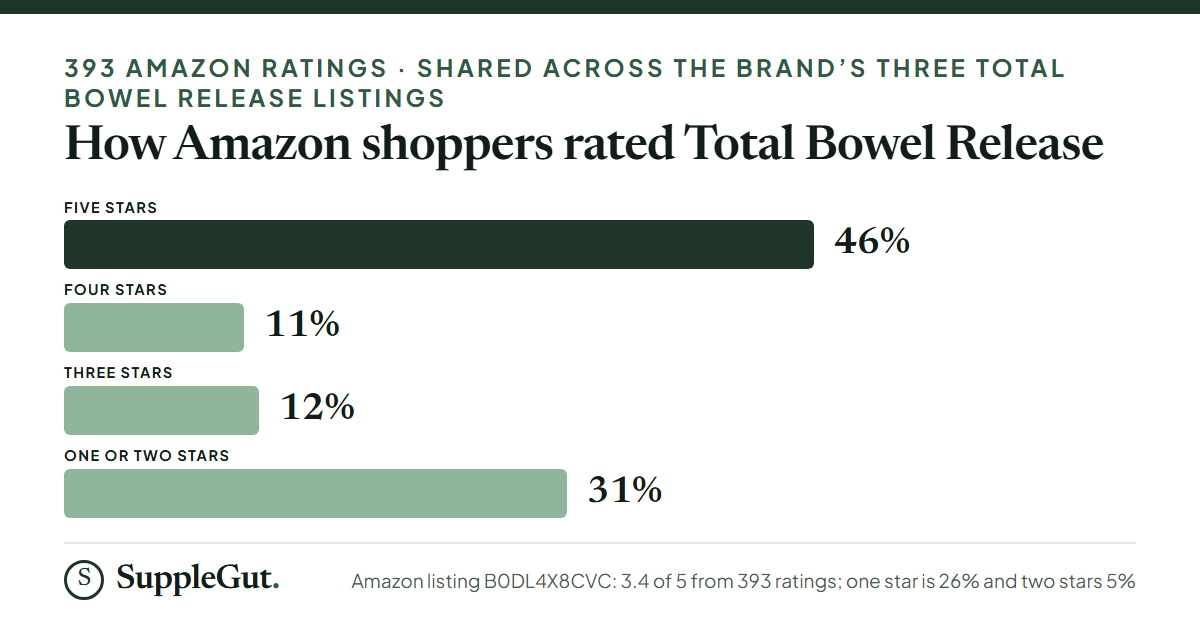
Amazon shows 3.4 from 393 ratings: 46% five-star, 11% four, 12% three, 5% two and 26% one. That single rating is shared across the brand’s three Total Bowel Release listings. The brand’s own Judge.me widget shows 3.02 from 43 reviews, 42 labeled verified buyers, with 16 five-star and 15 one-star; a few star scores do not match their text. Trustpilot shows 3.2 from 253 reviews, but that profile covers the whole company, mostly other products, and the company replies to most negative reviews.
The praise is consistent: regularity that does not feel like a laxative or bring urgency, an easy evening routine, and working where other products had not. The complaints are no effect, and constipation or bloating that worsened.
Subscription charges, delivery and the refund terms
The brand’s page lists a Subscribe & Save option at 10%; we did not read its cancellation terms. Reviewers on the brand’s widget and on Trustpilot report a subscription charge after they believed they had not enrolled, a request to stop charges, and orders that never arrived, one with a card charged and no refund because the seller could not find the order. These are reviewer reports from small samples.
The published guarantee is 90 days, provided bottles are shipped back with an unbroken seal; items showing tampering or damage are not refunded, so an opened bottle does not qualify on the page’s terms. The refund policy also says refund requests for purchases resold on third-party sites such as eBay or Amazon are not honored. Amazon purchases follow Amazon’s returns terms, which we did not read.
Cost
| Route | Price | Per day (28 servings a bottle) |
|---|---|---|
| Brand, 1 bottle | $49.95 | $1.78 |
| Brand, 3 bottles | $129.00 | $1.54 |
| Brand, 6 bottles | $197.00 | $1.17 |
| Amazon, 1 bottle | $49.95 | $1.78 |
| Amazon, Subscribe & Save | $44.95 | $1.61 |
The brand’s page also shows a first-order coupon banner and free shipping.
Who Total Bowel Release is for
- Someone who wants a daily regularity capsule with no senna, cascara or aloe latex and an amount printed for every ingredient.
- Someone comfortable that each active sits well below the doses in the trials, and that no trial covers the formula.
- Someone who has read the 90-day terms, including the sealed-bottle condition, before buying.
Other formulas in the same territory include Lanural Regularity Reset (magnesium oxide, kiwifruit and triphala extract; see its guide), Organic India Triphala as a single herb, and Bluegrass Move Easy (its guide). The constipation treatments guide grades the options by evidence, and the quiz matches symptoms to products.
The products in this catalog
Common questions
Does Revival Point Total Bowel Release work?
No trial of this formula was found. Amazon shows 3.4 from 393 ratings (46% five-star, 26% one-star) and the brand’s own review widget shows 3.02 from 43 reviews, with reviewers split between working within a day and doing nothing. Two whole green kiwifruit a day helped constipated adults in a 184-person trial, against 300 mg of extract in two capsules here.
What is in Total Bowel Release, and is it a laxative?
Two capsules hold kiwifruit extract 300 mg, triphala 250 mg, aloe vera inner leaf gel 50 mg, Bifidobacterium lactis 5 billion CFU, magnesium (citrate) 50 mg, vitamin D 25 mcg, thiamine 10 mg and vitamin B12 250 mcg. There is no senna, cascara or aloe latex; triphala is the one traditional laxative herb. The brand’s product-page text describes okra and ashwagandha, which are not on the bottle’s panel.
How much does Total Bowel Release cost per day?
A 28-serving bottle is $49.95 on the brand site and on Amazon, about $1.78 a day. The 3-bottle pack is $129 ($1.54 a day) and the 6-bottle pack $197 ($1.17). Amazon Subscribe & Save is $44.95 ($1.61), and the brand page lists a 10% subscription option.
Are there side effects, and who should check with a doctor?
The brand’s FAQ lists abdominal cramping or diarrhea, especially if the dose is too high, and some Amazon reviewers say it made constipation or bloating worse. The bottle says to consult a healthcare practitioner before use if taking other natural health products or prescription medication, or if there is a medical condition.
What is Revival Point’s refund policy?
The brand states a 90-day money-back guarantee, provided bottles are returned with an unbroken seal; items showing tampering or damage are not refunded. Its policy says it does not honor refund requests for purchases resold on third-party sites such as Amazon. Its Trustpilot profile (3.2 from 253 reviews, brand-wide) and review widget include reports of subscription charges and orders not received.
Does the bottle match the brand’s product page?
No. The page text describes an ayurvedic herb and a vegetable extract and names a compound called Digexin (ashwagandha with okra). The bottle, which reads new and improved formula, lists kiwifruit extract, triphala, aloe inner leaf gel and Bifidobacterium lactis instead. The bottle also holds 56 capsules, against 60 count in Amazon’s title.
Is Total Bowel Release like Lanural Regularity Reset?
Both combine kiwifruit and triphala, but Lanural’s third ingredient is 500 mg of magnesium oxide, the form used in the constipation trials, while this label has 50 mg of magnesium as citrate plus aloe gel and a probiotic. See the Lanural guide for its trial comparison.
Sources
- Gearry R, Fukudo S, Barbara G, et al. “Consumption of 2 Green Kiwifruits Daily Improves Constipation and Abdominal Comfort—Results of an International Multicenter Randomized Controlled Trial.” American Journal of Gastroenterology, 2023;118(6):1058–1068. doi.org/10.14309/ajg.0000000000002124
- Eltorki M, Leong R, Ratcliffe EM. “Kiwifruit and Kiwifruit Extracts for Treatment of Constipation: A Systematic Review and Meta-Analysis.” Canadian Journal of Gastroenterology and Hepatology, 2022;2022:7596920. doi.org/10.1155/2022/7596920
- van der Schoot A, Creedon A, Whelan K, et al. “The effect of food, vitamin, or mineral supplements on chronic constipation in adults: A systematic review and meta-analysis of randomized controlled trials.” Neurogastroenterology & Motility, 2023;35(11):e14613. doi.org/10.1111/nmo.14613
- van der Schoot A, Helander C, Whelan K, et al. “Probiotics and synbiotics in chronic constipation in adults: A systematic review and meta-analysis of randomized controlled trials.” Clinical Nutrition, 2022;41(12):2759–2777. doi.org/10.1016/j.clnu.2022.10.015
- Munshi R, Bhalerao S, Rathi P, et al. “An open-label, prospective clinical study to evaluate the efficacy and safety of TLPL/AY/01/2008 in the management of functional constipation.” Journal of Ayurveda and Integrative Medicine, 2011;2(3):144–152. doi.org/10.4103/0975-9476.85554
- Morishita D, Tomita T, Mori S, et al. “Senna Versus Magnesium Oxide for the Treatment of Chronic Constipation: A Randomized, Placebo-Controlled Trial.” American Journal of Gastroenterology, 2021;116(1):152–161. doi.org/10.14309/ajg.0000000000000942
- Revival Point brand page: product copy, FAQ, prices and review widget. revivalpoint.com/products/total-bowel-release
- Revival Point refund policy. revivalpoint.com/policies/refund-policy
- Bottle label: Supplement Facts, directions and warnings, from the brand’s product photographs; Amazon listing: title, price, count and ratings. amazon.com/dp/B0DL4X8CVC
- Trustpilot profile for revivalpoint.com (brand-wide). trustpilot.com/review/revivalpoint.com
Not sure which product fits your situation?
This guide covers the mechanics. The quiz takes your specific symptoms, routine and preferences and matches you to one product from the catalog.
Take the quiz →