
Guide
Does Wholesome Wellness Raw Probiotics work? Thirty-six coded strains, one CFU figure, and a doctor nobody names
Quick answer
Does Wholesome Wellness Raw Probiotics work? We could find no trial of this capsule. Its label prints 36 organisms with strain codes and one 100 billion CFU total at manufacture, with no count for any strain, and six of the codes match strains tested in small trials in children and in H. pylori therapy, none in adults with bloating. A 2023 meta-analysis of 82 trials rated combination probiotics as very low certainty for bloating and pain in IBS. Amazon shows 4.5 from 25,817 ratings, with 73% five-star; about one in six effectiveness mentions is negative.
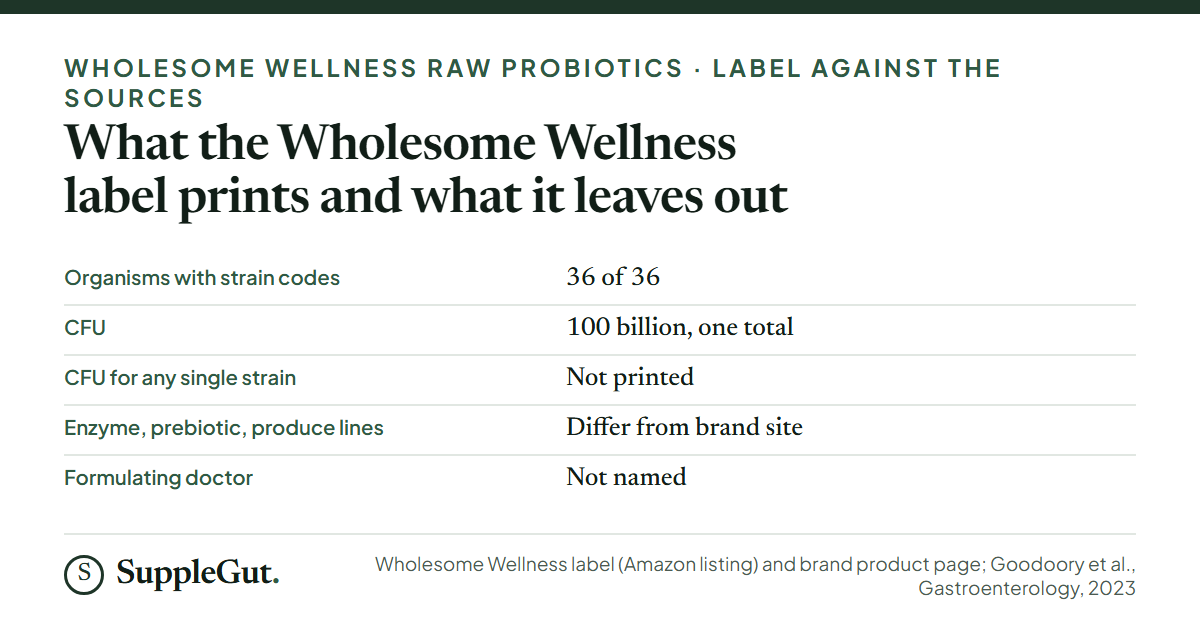
Wholesome Wellness Organic Raw Probiotics 100 Billion CFU is a once-a-day capsule that puts four things into 650 mg: a 250 mg complex of 36 organisms, 200 mg of digestive enzymes, 150 mg of an organic prebiotic blend and 50 mg of a fruit and vegetable powder. Its label prints a code after every organism name, but one 100 billion CFU figure covers all 36, no strain has its own count, and the doctor in “Dr. Formulated” is never named. This page sets out what the panel shows, which codes match published trials and in whom, and what the reviews and the brand’s own pages say.
What Wholesome Wellness Raw Probiotics is, and what it is not
The Supplement Facts panel on the Amazon label image lists one capsule as a serving and 30 servings to a bottle. The lines are a 100 Billion CFU Probiotic Complex of 250 mg, a Digestive Enzyme Complex of 200 mg, an Organic Prebiotic Complex of 150 mg and a Fruit and Vegetable Complex of 50 mg, which add up to 650 mg. The probiotic line carries a footnote: “formulated with 100 billion CFU at time of manufacture”. The capsule is hypromellose (a vegetable capsule); the other ingredients are magnesium stearate, silicon dioxide and microcrystalline cellulose. The bottle is a dietary supplement with no Drug Facts panel.
The enzyme line names 10 enzymes with activity units, among them amylase, protease, papain, lactase, lipase and bromelain; the Amazon text says “9 enzymes”. The prebiotic line is organic Jerusalem artichoke root, organic acacia gum and organic blue agave heart (90% inulin) with no amount for each. The fruit and vegetable line lists seven foods, including strawberry, carrot, tart cherry and prune, as one 50 mg blend, a small food-powder addition rather than a dose of any one ingredient.
Thirty-six coded organisms, and what “34 strains” counts
The bottle front and the Amazon listing say “34 strains”. The panel prints 36 organisms, every one with a code after the species name, such as Lactobacillus rhamnosus LRa05 or Bifidobacterium lactis BLa80. Two species appear twice, with two different codes each: L. plantarum (HP59 and Lp90) and L. acidophilus (SD5212 and LA85). So 34 is the number of distinct species or subspecies names, not the number of strains. Beyond Lactobacillus and Bifidobacterium, the list includes Bacillus coagulans, Bacillus subtilis, Enterococcus faecalis and the yeast Saccharomyces boulardii.
The codes are printed, which is more than some competing labels do, but none is a culture-collection deposit number, and the panel gives no count for any single organism. If the 100 billion were split equally it would be about 2.8 billion each; the label does not say it is split that way. Nothing is printed for CFU at the end of shelf life. The brand claims each of the 34 strains “has been shown in clinical trials” to affect health; we could not match that to the panel, since most of the 36 codes turned up no trial in our searches. The brand page itself says its trial counts are registered studies of the ingredients, not of this product.
“Dr. Formulated” and who stands behind it
The Amazon title, bullets and label image say doctor formulated. The brand site says the same for the original capsule, adds “gastroenterologist formulated” above the text for the separate women’s formula, and shows a physician-pick badge. No doctor is named on Amazon, the brand site or the seller profile: no name, credential, practice or license. We found no independent source confirming a formulating physician. That describes what is published, not whether a doctor was involved.
The company is also thinly described. The Amazon seller is “Wholesome Wellness Nutrition”, shipped by Amazon, with 4.9 seller feedback from 17,181 lifetime ratings (a rating of the seller, not of this product). The brand site names no owner, founder or address, and its homepage line “Trusted by 500,000+ customers” is a figure we could not verify.
The trial of the product itself
There is none. PubMed and ClinicalTrials.gov return nothing for the brand or product, and the NIH Dietary Supplement Label Database holds only an earlier label that lists organisms by species with no strain codes. Everything below is evidence for strains that share a code with the panel, or for the product class.
The trials that match strain codes
Six of the codes on the panel (LRa05, BLa80, BBr60, LR08, LCr86 and BC99) appear in published trials. Neither the brand nor the listing names a strain supplier, so the match is by code only, and several of the papers include authors employed by a strain supplier. None tested this capsule or a 36-organism mixture, and none enrolled adults with bloating.
| Code | Who and how long | Daily dose | Result |
|---|---|---|---|
| LRa05 | 111 children aged 0 to 3 with acute watery diarrhea | 5 billion CFU | Diarrhea lasted 121.4 hours against 143.9 on placebo |
| LRa05 | Patients on H. pylori bismuth quadruple therapy, 4 weeks, placebo-controlled | 10 billion CFU | Eradication 86.1% against 82.9%, not statistically significant; stomach-symptom scores reported lower |
| BLa80 | 360 healthy children aged 0 to 3, 3 months | 5 billion CFU | Eczema 26.1% against 66.7% |
| BLa80 + LRa05 | 112 adults who drink alcohol, 8 weeks | 20 billion CFU, both strains | Shifts in gut bacteria and short-chain fatty acids; no gut-symptom outcome |
| BLa80 + LRa05 + BBr60 | 80 adults with type 2 diabetes, 12 weeks | Not in the abstract | Inflammation markers and blood glucose lower than placebo |
The remaining matched codes (LR08, LCr86, BC99) appear in an obesity trial and a liver trial, also not gut-symptom studies. For the other 29 codes we found no trial in the searches we ran. These trials used 5 to 20 billion CFU a day for one strain or a pair; this label has 100 billion for all 36, split in a way it does not state.
The evidence for a many-strain capsule
The largest review of probiotics for irritable bowel syndrome pooled 82 randomized trials in 10,332 patients, only 24 of them at low risk of bias. It rated the certainty of benefit as very low for combination probiotics on global symptoms, abdominal pain, and bloating or distension, and found adverse events no more frequent than on placebo (Goodoory et al., Gastroenterology, 2023). An earlier review of 53 probiotic trials in 5,545 patients found which combinations or strains work in IBS “unclear” (Ford et al., Alimentary Pharmacology & Therapeutics, 2018). Results attach to defined strains at defined doses, and this label defines the first but not the second. For what a CFU total does and does not tell you, see how many CFU you need.
For the other three lines we found no trial of this combination: the 200 mg enzyme complex, the 150 mg prebiotic blend and the 50 mg produce powder were not searched individually. For enzymes, see do digestive enzymes work.
When the brand site and Amazon do not agree
The two sources print different amounts for three lines. The Amazon label image gives enzymes 200 mg, prebiotics 150 mg and fruit and vegetables 50 mg. The brand site’s text panel gives prebiotic fiber 200 mg, enzymes 50 mg and fruit and vegetables 100 mg, and calls the probiotic line “34 strains” where the image prints 36. This page uses the Amazon image because it is the legible label.
There is a second contradiction on the ingredient side. The brand homepage says “no flow agents, no magnesium stearate”. The Amazon panel lists magnesium stearate and silicon dioxide under other ingredients, and the Amazon bullets say “No: Binders… Additives, or Preservatives” beside a panel that also lists microcrystalline cellulose. Both statements are published; we report them and do not resolve them.
How to take it
The brand site’s directions are one capsule a day, with or without food, at the same time each day, and it says the capsule is safe to take alongside a multivitamin. The listing calls it shelf stable, stored in a cool, dry place away from humidity, heat and light. Nothing on the label says how long to try it; the trials above ran from a few weeks to three months.
Side effects and who should not take it
The Amazon safety text advises not to exceed the recommended dose, and says that pregnant or nursing mothers, children under 18, people with allergies or known medical conditions, and anyone taking medication should consult a physician before use. The panel includes Bacillus, Saccharomyces and Enterococcus organisms alongside the usual Lactobacillus and Bifidobacterium, so anyone with a condition affecting the immune system has a specific reason to ask a doctor or pharmacist first; see probiotic side effects for what the trials report. Amazon’s topic counts show 565 side-effect mentions, 97 (17%) of them negative.
The label image says “3rd Party Lab Tested” and the brand site cites an NSF and GMP registered US facility; no laboratory is named and no certificate of analysis was found. On allergens, the Amazon bullet lists what the product is free of: soy, gluten, milk, egg, wheat, peanuts and shellfish. It does not mention tree nuts, fish or sesame,. The label image carries Non-GMO, Gluten-Free and Vegan badges.
What the reviews say
Amazon shows 4.5 from 25,817 ratings: 73% five-star, 15% four, 7% three, 2% two and 3% one. In Amazon’s topic counts, effectiveness draws 1,456 mentions with 243 negative (about one in six), digestive effects 1,296 with 117 negative, and value for money 504 with 122 negative (about one in four).
The brand site shows 4.50 from 25,806 “verified buyers” reviews on the product page, within 11 of Amazon’s count. The page does not say whether Amazon reviews are imported, so the two should not be counted as two samples. The brand homepage claims 4.9 from “12,400+ verified reviews”, which matches neither figure. We found no Trustpilot profile and no Better Business Bureau record, and no Reddit threads are included.
The recurring praise is less bloating and easier digestion, more regular bowel movements, a small capsule that is easy to swallow and a bottle that needs no refrigerator. The recurring complaints are no change in bloating, the price per capsule, and subscription timing: one reviewer reported a delayed auto-ship and another said a free second bottle had been promised and did not arrive; we could not determine whether an offer is attached to this product.
Price, subscription and refund terms
Prices by route, at one capsule a day:
| Where and size | Price | Per day |
|---|---|---|
| Amazon, 30 capsules, one time | $25.99 | $0.87 |
| Amazon, 30 capsules, Subscribe & Save | $23.39 | $0.78 |
| Brand site, 30 capsules, one time | $32.99 | $1.10 |
| Brand site, subscription (15% off, every 30 days) | $28.04 | $0.93 |
| Brand site, 3-bottle subscription bundle | $26.39 a bottle | $0.88 |
| Brand site, 6-bottle subscription bundle | $24.74 a bottle | $0.82 |
Amazon shows $32.99 as the reference price and describes Subscribe & Save as “No fees, Cancel anytime”. The brand site says subscriptions can be skipped, paused or cancelled in one click and advertises a “365-day money-back guarantee” that includes subscriptions; we did not find the written policy behind that claim. A single bottle can be bought without a subscription on both routes. With no Trustpilot or BBB record and Amazon text behind a sign-in, we could read no refund or billing complaint pattern; that is an absence of data, not evidence either way.
Who Wholesome Wellness Raw Probiotics is for
- Someone who wants a probiotic, enzymes and a prebiotic in one daily capsule and will judge it by how they feel over several weeks.
- Someone who prefers a label with a code after every organism, and accepts a single CFU total with no per-strain counts.
Other pages show different trade-offs. Vitalitown 120 Billion prints 36 names with no strain codes and a different enzyme dose, covered in its own guide. Garden of Life RAW Probiotics Ultimate Care is another 100 billion CFU capsule, a 34-organism blend in which four strains are disclosed at strain level. Seed DS-01 is a 24-strain synbiotic with a company-funded trial on the finished formula, covered in its own guide; no trial compares any of these with Wholesome Wellness. To choose among types, see which probiotic to take or the quiz.
The products in this catalog
Common questions
Does Wholesome Wellness Raw Probiotics work?
No trial of this capsule was found. Some of its strain codes match strains tested in small trials at 5 to 20 billion CFU a day, none in adults with bloating, and a 2023 meta-analysis of 82 IBS trials rated combination probiotics as very low certainty for bloating and pain. On Amazon 73% of 25,817 ratings are five-star, and about 17% of effectiveness mentions are negative.
Who is the doctor behind “Dr. Formulated” Wholesome Wellness?
No doctor is named. The Amazon listing, the label image, the brand site and the seller page say doctor formulated, and the site adds gastroenterologist formulated for the women’s version, without a name, credential or practice. We found no independent source confirming a formulating physician.
Is it 34 strains or 36?
The bottle and listing say 34 strains, and the panel prints 36 organisms, each with a code. Two species appear twice (L. plantarum and L. acidophilus, each with two codes), so 34 counts distinct species or subspecies names, not strains. The panel gives one 100 billion CFU total and no count for any organism.
Is 100 billion CFU too much, and does it have side effects?
We found no trial showing that a higher total gives better results, and the single-strain trials we found used 5 to 20 billion CFU a day. The label advises consulting a physician if you are pregnant or nursing, under 18, have a medical condition or take medication. About 17% of side-effect mentions on Amazon are negative, and see the CFU guide for what the figure measures.
How much does Wholesome Wellness Raw Probiotics cost?
A 30-capsule bottle is $25.99 on Amazon, which is $0.87 a day at one capsule, or $0.78 a day with Subscribe & Save at $23.39. The brand’s own site lists $32.99 ($1.10 a day), $28.04 with its 15% subscription ($0.93 a day), and $26.39 and $24.74 a bottle on 3- and 6-bottle subscription bundles.
Why do the brand site and Amazon list different amounts?
The Amazon label image gives enzymes 200 mg, prebiotics 150 mg and fruit and vegetables 50 mg. The brand site’s text gives 50, 200 and 100 mg, and says 34 strains where the image prints 36. The brand homepage also says no magnesium stearate, while the Amazon panel lists it. We could not determine which panel is current.
Does it need refrigeration, and how do you take it?
The listing calls it shelf stable, to be stored in a cool, dry place away from humidity, heat and light. The brand site says to take one capsule a day with or without food at the same time each day. Nothing on the label says how long to try it; which probiotic to take covers how to choose.
Sources
- Goodoory VC, et al. Meta-analysis of probiotics in irritable bowel syndrome (82 randomized trials, 10,332 patients). Gastroenterology, 2023. PMID 37541528
- Ford AC, et al. Systematic review and network meta-analysis of prebiotics, probiotics, synbiotics and antibiotics in irritable bowel syndrome (53 probiotic trials, 5,545 patients). Alimentary Pharmacology & Therapeutics, 2018. PMID 30294792
- Chen K, et al. Lacticaseibacillus rhamnosus LRa05 in acute watery diarrhea, 111 children aged 0 to 3. Frontiers in Nutrition, 2024. PMID 39619284
- Niu Y, et al. LRa05 with bismuth quadruple therapy for H. pylori, randomized placebo-controlled. Frontiers in Immunology, 2024. PMID 39234246
- Chen K, et al. Bifidobacterium lactis BLa80 in 360 healthy children aged 0 to 3. Clinical and Experimental Pediatrics, 2025. PMID 41167178
- Liu Y, et al. BLa80 with LRa05 in 112 adults who drink alcohol. Beneficial Microbes, 2025. PMID 40527514
- Zhu S, et al. BLa80, LRa05 and BBr60 in 80 adults with type 2 diabetes. Food Science & Nutrition, 2026. PMID 41971606
- Amazon listing: Supplement Facts label image, bullets, price, rating split and seller. amazon.com/dp/B0811P73BT
- Brand page: panel text, directions, price and subscription terms. wholesomewellness.com/products/raw-probiotics.html
- Brand homepage: review, customer and ingredient claims. wholesomewellness.com
Not sure which product fits your situation?
This guide covers the mechanics. The quiz takes your specific symptoms, routine and preferences and matches you to one product from the catalog.
Take the quiz →