
Guide
Which gut supplement is right for me? A symptom-by-symptom answer
Quick answer
Which gut supplement is right for me? It follows from the symptom. Constipation: psyllium. Loose stools on antibiotics: L. rhamnosus GG or S. boulardii. IBS-type cramping and urgency: enteric-coated peppermint oil or B. longum 35624. Gas after particular foods: the matching enzyme. Reflux: alginate. Fullness and nausea after meals: the six-herb Iberogast formula. A stress-driven gut: the IBS options above, with the caveat that the strongest evidence is a therapy, not a supplement. Nothing in particular: nothing has a trial that says it helps.
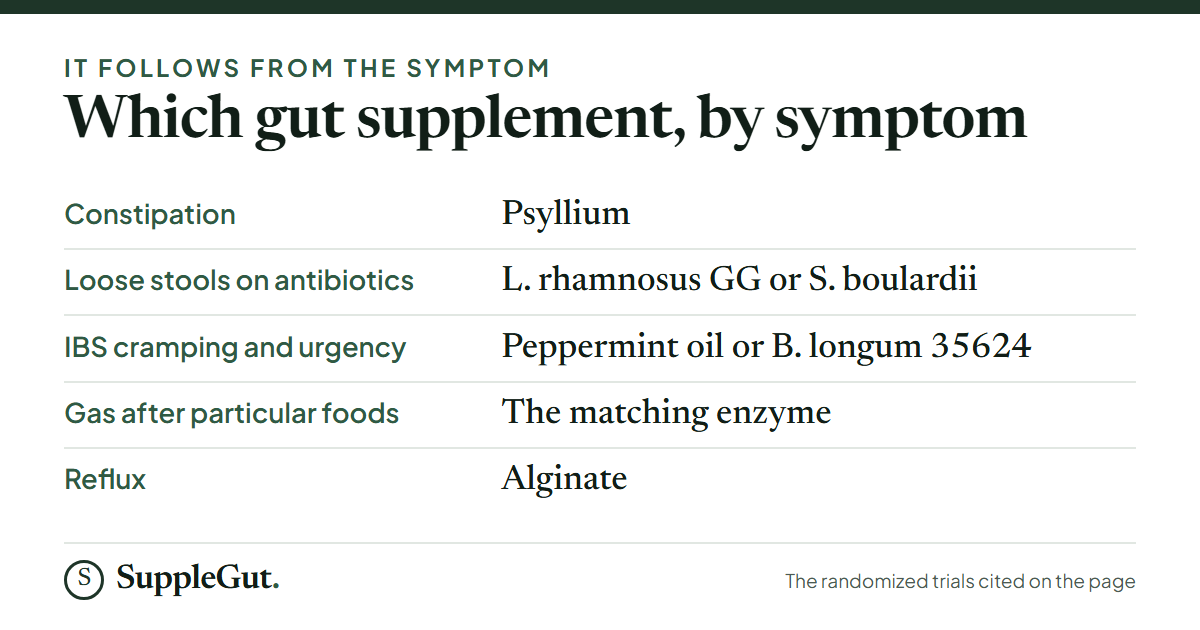
The quiz on this site asks eight questions to sort this out. This page is the same logic written down: for each kind of gut trouble, the category with the trials, the size of those trials, and the product in the catalog that carries the tested ingredient. Read the section that sounds like you.
Constipation, or stools that come and go
Psyllium. A meta-analysis of 16 randomized trials in 1,251 adults found fiber helped 66% against 41% on control, with the effect belonging to psyllium and pectin at doses above 10 g a day for at least four weeks (van der Schoot et al., 2022). The 2023 gastroenterology guideline puts polyethylene glycol ahead of it and probiotics nowhere (Chang et al., 2023). For stools that swing between hard and loose, psyllium’s gel works in both directions: 10 g a day helped 57% of IBS patients of any bowel habit against 35% on placebo (Bijkerk et al., 2009). The constipation guide and the Metamucil dosage guide cover the dose.
Loose stools and urgency
During antibiotics, L. rhamnosus GG (12 trials, 1,499 people, diarrhea cut from 22.4% to 12.3%) or S. boulardii (21 trials, 4,780 people), at 5 billion CFU a day or more (Szajewska and Kołodziej, 2015; McFarland, 2010). For diarrhea-predominant IBS, the Bio-Kult formula has the largest trial, 400 adults over 16 weeks (Ishaque et al., 2018), and psyllium helps here too. The loose-stools guide sorts by cause.
Bloating and gas
Depends on what drives it. For bloating with IBS-type cramping, enteric-coated peppermint oil has the most trials: nine randomized trials in 726 people (Khanna et al., 2014). For most-days bloating without a food pattern, two probiotics have placebo-controlled bloating results, B. longum 35624 in 362 women (Whorwell et al., 2006) and Seed DS-01 in 350 adults (Allegretti et al.). Fermentable fibers make gas, so a fiber supplement is usually the wrong first move. The bloating guide has the full sort.
Certain foods set it off
Then the supplement is an enzyme matched to the food, not a probiotic. For dairy, lactase: a placebo-controlled crossover trial of 13,500 FCC of lactase before a lactose load cut breath hydrogen by 55% with fewer symptoms (Baijal and Tandon). For beans and vegetables, alpha-galactosidase, which has placebo-controlled trials of its own on gas after a test meal (Di Stefano et al., 2007). The broad multi-enzyme blends have far less behind them; the enzymes guide says how much.
Reflux, heartburn or nausea
Alginate for reflux: 14 randomized trials in 2,095 patients, beating placebo and antacids with an odds ratio of 4.42, though not a PPI (Leiman et al., 2017). For queasiness and fullness rather than burning, see the next section. Probiotics, ginger and zinc carnosine sit on much thinner reflux evidence, and the reflux guide grades each.
Heavy, slow digestion after meals
That is the functional dyspepsia picture, and its evidence is herbal. The six-herb Iberogast formula sold in the US has a 2024 patient-data meta-analysis of four randomized trials in 613 people (Andresen et al., 2024), and a caraway-oil and menthol capsule improved fullness in a four-week trial of 95 people (Chey et al., 2019). The IBgard vs Iberogast comparison is the line between this picture and the IBS one.
Stress or anxiety hits my gut
The strongest evidence is not a supplement: gut-directed hypnotherapy and cognitive behavioral therapy cut the chance of IBS symptoms persisting by about a third across 41 trials (Black et al., 2020). For the gut symptoms stress sets off, the IBS options above apply, and melatonin at 3 mg has one trial in 40 people with IBS and poor sleep (Song et al., 2005). The stress guide covers what probiotics do and do not do for anxiety itself.
Nothing specific, just everyday support
No trial says a daily probiotic helps a healthy gut, and the dose-response reviews find no link between CFU and benefit for general gut health (Ouwehand, 2017). If your diet is short of fiber, psyllium closes that gap with the evidence above; if you want a probiotic, choose a named strain at a stated dose and treat the CFU count as a label, not a strength. The most-researched guide lists what has the trials.
What the quiz adds to this page
The things a page cannot ask. Your age, and whether you are pregnant or breastfeeding, which rule some labels out. Your prescription medicines, which the quiz checks ingredient by ingredient against the products it might name. What you have tried and whether it worked. Whether it has to be a capsule, whether once a day matters, what a month can cost, and whether the label has to be dairy-free, vegan or gluten-free. Then it scores every product on the research, the customer experience and the label, and prints the reasons for the one it picks. For how it sits beside the other quizzes and the stool tests, see gut health quizzes compared.
Let the quiz do the sorting
Eight questions, then one product with its reasons. Free, private, no sign-up.
Take the quiz →One product per picture, from this catalog
Common questions
What is the best gut health supplement overall?
There is no overall best, because the trials are run on one ingredient for one problem. Psyllium has the most constipation trials, L. rhamnosus GG and S. boulardii the most antibiotic-diarrhea trials, peppermint oil the most IBS trials, and alginate the most reflux trials. The right one is the one tested for what you have.
Do I need a probiotic, a fiber or an enzyme?
Fiber for hard or infrequent stools; a probiotic for diarrhea during antibiotics or for IBS-type symptoms with a strain that has been tested; an enzyme when one food reliably sets it off, lactase for dairy and alpha-galactosidase for beans and vegetables. Bloating with no pattern points to peppermint oil or one of two probiotics, and reflux to alginate.
What supplement helps with bloating and gas?
For bloating with cramping, enteric-coated peppermint oil (nine randomized trials in 726 people). For most-days bloating, B. longum 35624 (362 women) or Seed DS-01 (350 adults). For gas after particular foods, the matching enzyme. Fiber supplements usually make gas worse.
What should I take for a stress-related gut?
The strongest evidence is a therapy rather than a supplement: gut-directed hypnotherapy and cognitive behavioral therapy cut the chance of IBS symptoms persisting by about a third across 41 trials. For the gut symptoms themselves, the IBS options apply, and melatonin at 3 mg has one trial in people with IBS and poor sleep.
Is there a supplement for everyday gut health?
Nothing with a trial that says it helps a healthy gut. Dose-response reviews find no link between CFU and benefit for general gut health. If your diet is short of fiber, psyllium closes that gap with real evidence; a probiotic for everyday use should at least name its strain and state a CFU through the best-by date.
How does the SuppleGut quiz decide?
It asks eight questions about the symptom, its pattern, your age, pregnancy, prescription medicines, what you have tried, and your preferences on format, budget and diet. It then scores every product on the research, the customer experience and the label, removes anything its label rules out for your situation, and prints the reasons for the one it names.
Sources
- van der Schoot A, et al. "The Effect of Fiber Supplementation on Chronic Constipation in Adults." American Journal of Clinical Nutrition, 2022. pmc.ncbi.nlm.nih.gov/articles/PMC9535527
- Chang L, et al. "AGA-ACG Clinical Practice Guideline: Pharmacological Management of Chronic Idiopathic Constipation." 2023. pubmed.ncbi.nlm.nih.gov/37211380
- Bijkerk CJ, et al. "Soluble or insoluble fibre in irritable bowel syndrome in primary care?" BMJ, 2009. pubmed.ncbi.nlm.nih.gov/19713235
- Szajewska H, Kołodziej M. "Lactobacillus rhamnosus GG in the prevention of antibiotic-associated diarrhoea in children and adults." 2015. pubmed.ncbi.nlm.nih.gov/26365389
- McFarland LV. "Systematic review and meta-analysis of Saccharomyces boulardii in adult patients." 2010. pubmed.ncbi.nlm.nih.gov/20458757
- Ishaque SM, et al. "A randomized placebo-controlled clinical trial of a multi-strain probiotic formulation (Bio-Kult) in the management of diarrhea-predominant irritable bowel syndrome." 2018. pubmed.ncbi.nlm.nih.gov/29801486
- Khanna R, MacDonald JK, Levesque BG. "Peppermint oil for the treatment of irritable bowel syndrome: a systematic review and meta-analysis." 2014. pubmed.ncbi.nlm.nih.gov/24100754
- Whorwell PJ, et al. "Efficacy of an encapsulated probiotic Bifidobacterium infantis 35624 in women with irritable bowel syndrome." 2006. pubmed.ncbi.nlm.nih.gov/16863564
- Allegretti JR, et al. "A Randomized, Placebo-Controlled Trial Evaluating Multi-Species Synbiotic Supplementation for Bloating, Gas, and Abdominal Discomfort." pmc.ncbi.nlm.nih.gov/articles/PMC12845427
- Baijal R, Tandon RK. "Effect of lactase on symptoms and hydrogen breath levels in lactose intolerance: a crossover placebo-controlled study." pubmed.ncbi.nlm.nih.gov/33490624
- Di Stefano M, et al. "The effect of oral alpha-galactosidase on intestinal gas production and gas-related symptoms." 2007. pubmed.ncbi.nlm.nih.gov/17151807
- Leiman DA, et al. "Alginate therapy is effective treatment for GERD symptoms: a systematic review and meta-analysis." 2017. pmc.ncbi.nlm.nih.gov/articles/PMC6036656
- Andresen V, et al. "STW 5-II in functional dyspepsia: patient-data meta-analysis of four trials, 613 patients." Digestion, 2024. pubmed.ncbi.nlm.nih.gov/38246134
- Chey WD, et al. "A Novel, Duodenal-Release Formulation of a Combination of Caraway Oil and L-Menthol for the Treatment of Functional Dyspepsia." 2019. pubmed.ncbi.nlm.nih.gov/30939487
- Black CJ, et al. "Efficacy of psychological therapies for irritable bowel syndrome: systematic review and network meta-analysis." Gut, 2020. pubmed.ncbi.nlm.nih.gov/32276950
- Song GH, et al. "Melatonin improves abdominal pain in irritable bowel syndrome patients who have sleep disturbances." Gut, 2005. pubmed.ncbi.nlm.nih.gov/15914575
- Ouwehand AC. "A review of dose-responses of probiotics in human studies." 2017. pubmed.ncbi.nlm.nih.gov/28008787
Not sure which product fits your situation?
This guide covers the mechanics. The quiz takes your specific symptoms, routine and preferences and matches you to one product from the catalog.
Take the quiz →