Guide
Does Codeage Leaky Gut Formula work? Nineteen ingredients, one at a trial dose, and no study of the capsule
Quick answer
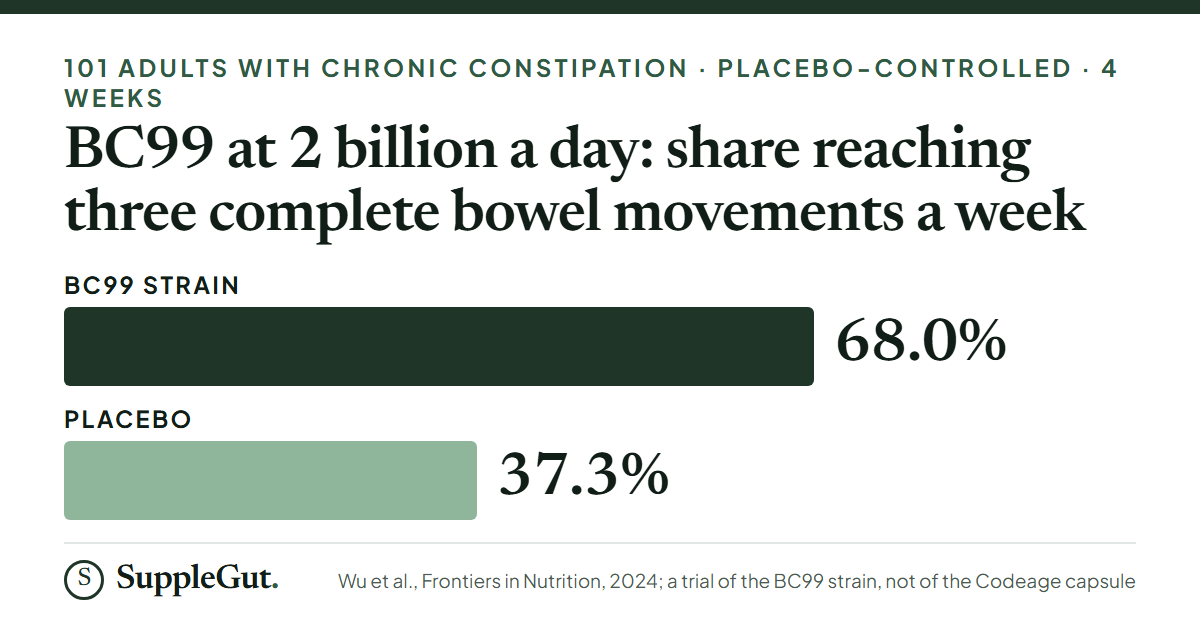
Does Codeage Leaky Gut Formula work? We found no trial of the formula itself. One ingredient matches a trial: the current label prints the probiotic strain Bacillus coagulans BC99 at 2.3 billion cells, and BC99 at 2 billion a day raised the share of constipated adults reaching three complete bowel movements a week to 68%, against 37% on placebo. The lead actives sit far below their trial doses, with 315 mg of glutamine against 15 g a day. On iHerb it holds 4.8 from 2,351 ratings.
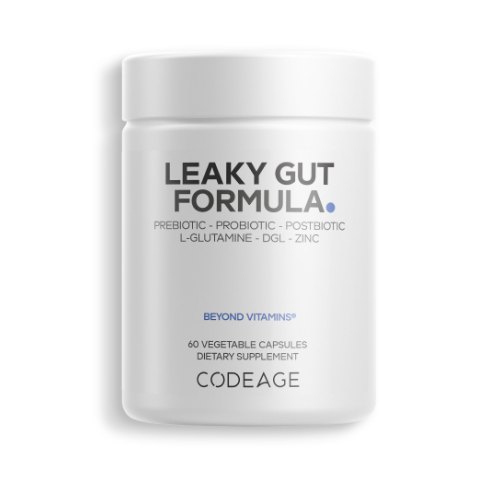
Codeage Leaky Gut Formula is a two-capsule daily blend that Codeage builds “around the gut lining”: L-glutamine, N-acetylglucosamine and butyric acid as the three lead actives, with zinc carnosine, vitamin D3, two probiotics, DGL, berberine and ten smaller lines of herb, fruit and mushroom extracts. What sets the current label apart is that it names both probiotic strains, and one of them, BC99, has a placebo-controlled trial at the amount printed. This page sets out the label, the trial dose behind each ingredient, the reviews, the refund rules and the cost.
What a two-capsule serving of Codeage Leaky Gut Formula holds
The Supplement Facts panel on Codeage’s product page gives a serving as two capsules, with 30 servings in a 60-capsule bottle:
| Ingredient as printed | Per serving |
|---|---|
| L-glutamine | 315 mg |
| Vegan N-acetylglucosamine | 210 mg |
| Butyric acid (from calcium butyrate) | 127 mg |
| Saccharomyces boulardii SB01 | 112.5 mg (1.2 billion viable cells at expiration) |
| Deglycyrrhizinated licorice (DGL) root extract | 75 mg |
| Bacillus coagulans BC99 | 75 mg (2.3 billion viable cells at expiration) |
| Zinc (from zinc L-carnosine) | 6 mg |
| Vitamin D3 (from lichen) | 10 mcg (400 IU) |
| Berberine (from berberine HCl) | 10 mg |
| Ten smaller lines | Cinnamon bark 50 mg, maitake extract 50 mg, a six-fruit polyphenol blend 42.5 mg, quercetin 42.5 mg, slippery elm bark 42.5 mg, ginger extract 30 mg, grapefruit seed extract 20 mg, chamomile 20 mg, marshmallow root extract 10 mg, BioPerine black pepper extract 5 mg |
The capsule shell is methylcellulose, with no sweetener or flavor, and the polyphenol blend is the only line without amounts for each part. The panel prints the zinc, not the weight of the zinc carnosine that supplies it; zinc carnosine is about 23% zinc, so 6 mg of zinc implies roughly 27 mg of the complex, an estimate rather than a label figure. The bottle front says “Prebiotic - Probiotic - Postbiotic,” but no line on the panel is a prebiotic fiber such as inulin. The brand states the capsules are vegan and made without dairy, soy or gluten, and tested by an independent laboratory it does not name.
Two versions of this label are on sale. Codeage’s own panel prints the strain codes SB01 and BC99 and counts the cells at expiration. The copy of the label on iHerb prints no strain codes, gives the two counts the other way round (2.3 billion S. boulardii, 1.2 billion B. coagulans), counts them at manufacture and lists cassia instead of Ceylon cinnamon. The BC99 trial below applies only to a bottle that prints the code.
No study of Codeage Leaky Gut Formula itself
A PubMed search for Codeage and for the product name, and a ClinicalTrials.gov search for Codeage, found no trial of this formula, and the product page cites none. “Leaky gut” is shorthand for raised intestinal permeability, which researchers measure with probe molecules swallowed by mouth or with gut biopsies. A review in Gut by a Mayo Clinic gastroenterologist describes how anti-inflammatory drugs, endurance exercise and other stresses raise permeability, and states that it is still unproven that restoring barrier function improves gut or whole-body symptoms (Camilleri, Gut, 2019). The evidence that does exist is for the ingredients one at a time.
Each ingredient against the dose in its trial
| Ingredient | On the label | In the trial | What the trial found |
|---|---|---|---|
| L-glutamine | 315 mg | 15 g a day for 8 weeks; 106 adults with IBS-D that began after an infection | 79.6% met the main symptom goal, against 5.8% on placebo |
| N-acetylglucosamine | 210 mg | 3 to 6 g a day added to treatment; 12 children with severe IBD; no placebo group | 8 of 12 improved; 4 still needed surgery |
| Butyric acid | 127 mg, as calcium butyrate | Coated sodium butyrate added to usual treatment; 66 adults with IBS; 12 weeks | Less pain during bowel movements and less urgency; abdominal pain not significantly reduced |
| Zinc carnosine | 6 mg of zinc (about 27 mg of the complex, estimated) | 75 mg a day; 10 volunteers taking indomethacin | Gut permeability did not rise significantly |
| Berberine | 10 mg | 400 mg a day in two doses; 132 adults with IBS-D; 8 weeks | Less frequent diarrhea, abdominal pain and urgency |
| S. boulardii | 1.2 billion cells, strain SB01 | The species across 21 trials; 4,780 people taking antibiotics | Antibiotic-associated diarrhea fell from 18.7% to 8.5% |
| B. coagulans | 2.3 billion cells, strain BC99 | The same strain at 2 billion a day; 101 adults with chronic constipation; 4 weeks | 68.0% responded, against 37.3% on placebo |
The gap is widest for the lead actives. The label carries about 2% of the 15 g of glutamine a day used in the post-infectious IBS trial (Zhou et al., Gut, 2019), and a meta-analysis of ten randomized trials with 352 participants found no overall effect of glutamine on gut permeability, with a reduction only in the subgroup given more than 30 g a day (Abbasi et al., Amino Acids, 2024). The N-acetylglucosamine study was an uncontrolled pilot in children with treatment-resistant Crohn’s disease or colitis, and its authors called for controlled trials (Salvatore et al., 2000). The butyrate trial tested a coated sodium salt, not the calcium butyrate printed here (Banasiewicz et al., 2013). The estimated zinc carnosine is about a third of the 75 mg a day in the indomethacin study (Mahmood et al., Gut, 2007), and the 10 mg of berberine is one-fortieth of the IBS-D trial dose (Chen et al., 2015). We found no trial of DGL at 75 mg for gut symptoms, and the ten smaller lines hold between 5 and 50 mg each.
BC99, the one strain printed at a trial dose
The Bacillus coagulans strain BC99 has a placebo-controlled trial of its own. Chinese adults aged 18 to 65 with chronic constipation took 2 billion CFU of BC99 a day or a maltodextrin placebo for four weeks. Of the 101 who finished, 68.0% on BC99 averaged three or more complete bowel movements a week, with at least one more than at the start, against 37.3% on placebo, and their constipation symptom and quality-of-life scores improved more (Wu et al., Frontiers in Nutrition, 2024). The strain-coded Codeage label prints 2.3 billion cells counted at expiration, at or above that dose. The trial measured constipation, not gut permeability, and it tested the strain on its own.
The yeast Saccharomyces boulardii has a larger record as a species: across 21 trials in 4,780 people on antibiotics, it cut antibiotic-associated diarrhea from 18.7% to 8.5% (Szajewska & Kołodziej, 2015). Codeage makes no antibiotic claim for this formula, and we found no study of the strain it calls SB01.
How to take it, and how long a fair test runs
The label direction is two capsules a day, or as a healthcare professional directs; the label copy on iHerb adds 8 oz of water or another drink, with or without food. Codeage’s own photo puts each capsule at 0.90 in long. No study sets a timeline for the formula itself. The BC99 trial measured its result at four weeks, and one 30-serving bottle covers that span.
Side effects, surgery and the label warnings
The label asks anyone pregnant, nursing, under 18 or with a known medical condition to consult a physician first, and adds medication to that list in its directions. It says not to exceed the dose, to take care with allergies to any listed ingredient, and not to use the product for weight reduction. The label copy on iHerb also says to stop two weeks before surgery. In the reviews, the complaint about the capsules themselves is the smell: one reviewer holds their nose to swallow them, and others mention a strong taste. A minority report a worse or upset stomach; one blamed the zinc for nausea, and one reviewer on Codeage’s site said their gut hurt all night after the first dose. The probiotic side effects guide covers reactions to probiotics in general.
What iHerb, Walmart and Codeage’s own widget show
The largest pool is on iHerb, an independent retailer: 4.8 out of 5 from 2,351 ratings, 85% of them five-star and 18 one-star, written mostly in English, Russian and Ukrainian. The 80 newest were all marked as verified purchases: 68 five-star, 7 four-star, 3 three-star and 2 one-star. Walmart shows 4.6 from 74 ratings, a figure that includes reviews collected on other sites; several of its visible reviews are the same texts that appear on Codeage’s page, where a Bazaarvoice widget shows 4.8 from 52. Codeage’s Trustpilot profile covers the whole company, at 4.6 from 1,187 reviews. We could not read Amazon or Reddit.
Praise centers on less bloating and calmer digestion within days or a few weeks, more regular bowel movements, and having glutamine, zinc, butyrate and probiotics in one capsule. The complaints are the smell, a stomach that got worse for a few, and no change for others; one five-star reviewer noted that the glutamine dose is low.
Codeage’s refund rules and Subscribe & Save
Codeage advertises a 30-day money-back guarantee, and its refund policy sets the conditions: one refund per customer for life, applied to the first order and to one item from it. Sale, promotional and multi-buy items are excluded, bundles come back only if every unit is unopened, and return shipping is deducted from the refund. Subscribe & Save takes 15% off for delivery every one, two or three months; the guarantee covers only the first subscription order, Codeage emails at least two days before each order, and subscribers can skip, pause or cancel in their account. Single bottles are also sold at iHerb and Walmart.
Who Codeage Leaky Gut Formula suits, and other routes
- Someone who wants one capsule routine covering glutamine, N-acetylglucosamine, butyrate, zinc carnosine and two probiotics, knowing most of them sit well below their trial doses.
- Someone with constipation who wants the BC99 strain, and who checks that the bottle prints the code.
- Someone who needs a vegan formula: the N-acetylglucosamine here is printed as vegan.
For glutamine at the dose the IBS trial used, a single-ingredient powder such as Thorne L-Glutamine fits; the Wellah glutamine guide sets out that evidence. Gundry MD Total Restore builds on the same glutamine, zinc carnosine and N-acetyl-D-glucosamine, the last from shellfish, and the Liver Medic Leaky Gut Repair guide covers another leaky-gut blend. Single-species options are Florastor for S. boulardii (see Culturelle vs Florastor) and Thorne Bacillus Coagulans, which does not name its strain.
What a day of Codeage Leaky Gut Formula costs
A 60-capsule bottle is $29.99 on Codeage’s site, iHerb and Walmart: $1.00 a day at two capsules. Subscribe & Save on Codeage’s site brings it to $25.49, about $0.85 a day. Codeage’s free shipping starts at $50 for one-time orders.
The products in this catalog
Codeage Leaky Gut Formula: common questions
What is in Codeage Leaky Gut Formula?
Two capsules hold L-glutamine 315 mg, vegan N-acetylglucosamine 210 mg, butyric acid 127 mg as calcium butyrate, zinc 6 mg from zinc L-carnosine, vitamin D3 400 IU, DGL 75 mg and berberine 10 mg. The probiotics are Saccharomyces boulardii SB01 at 1.2 billion cells and Bacillus coagulans BC99 at 2.3 billion, counted at expiration. Ten smaller lines of herb, fruit and mushroom extracts follow at 5 to 50 mg each, in a methylcellulose capsule with no sweetener.
Does Codeage Leaky Gut Formula have side effects?
The label names no specific side effect. It asks anyone pregnant, nursing, under 18, on medication or with a medical condition to check with a physician first, and the label copy on iHerb says to stop two weeks before surgery. Reviewers most often mention the capsules’ strong smell, and a few report a worse or upset stomach; one blamed the zinc for nausea.
What complaints come up in Codeage reviews?
On iHerb, where the formula holds 4.8 from 2,351 ratings, the recurring complaints are the smell, an upset stomach for a few and no noticeable change for some. Codeage’s company profile on Trustpilot holds 4.6 from 1,187 reviews, and its recent low ratings are mostly about orders that did not arrive. The refund policy allows one refund per customer, on the first order, within 30 days, with return shipping paid by the customer.
What do Reddit users say about Codeage Leaky Gut Formula?
We could not read Reddit threads for this page. The largest open review pool we could read is iHerb’s, where the 80 newest reviews were all marked as verified purchases and 68 of them gave five stars. Walmart shows 4.6 from 74 ratings, partly collected on other sites.
How do you take Codeage Leaky Gut Formula, and how soon does it work?
Two capsules a day, with 8 oz of water or another drink, with or without food, according to the label copy on iHerb. No study has timed the formula itself. Many iHerb reviewers describe less bloating within days to a few weeks, and the trial of its BC99 strain measured its result at four weeks.
Is there enough glutamine in Codeage Leaky Gut Formula to match the studies?
The label has 315 mg per serving, and the trial in post-infectious IBS used 15 g a day, about 48 times as much. A meta-analysis of ten trials found glutamine lowered gut permeability only above 30 g a day. Single-ingredient powders such as Thorne L-Glutamine are dosed in grams.
How does Codeage Leaky Gut Formula compare with Gundry MD Total Restore?
Both are gut-lining capsules built on glutamine, zinc carnosine and N-acetylglucosamine, and neither has a trial of the finished product. Codeage takes two capsules for 315 mg of glutamine and adds two named probiotic strains and butyrate; Total Restore takes three capsules for 213 mg of glutamine, and its N-acetyl-D-glucosamine comes from shellfish. The Total Restore guide has its label and trials.
Sources
- Zhou Q, Verne ML, Fields JZ, et al. “Randomised placebo-controlled trial of dietary glutamine supplements for postinfectious irritable bowel syndrome.” Gut, 2019;68(6):996–1002. PubMed 30108163
- Abbasi F, Haghighat Lari MM, Khosravi GR, et al. “A systematic review and meta-analysis of clinical trials on the effects of glutamine supplementation on gut permeability in adults.” Amino Acids, 2024;56(1):60. PubMed 39397201
- Wu Y, Bai Z, Jin Y, et al. “A randomized, double-blind, placebo-controlled clinical study to evaluate the efficacy and safety of Weizmannia coagulans BC99 in the treatment of chronic constipation in adults.” Frontiers in Nutrition, 2024;11:1395083. PubMed 39119466
- Salvatore S, Heuschkel R, Tomlin S, et al. “A pilot study of N-acetyl glucosamine, a nutritional substrate for glycosaminoglycan synthesis, in paediatric chronic inflammatory bowel disease.” Alimentary Pharmacology & Therapeutics, 2000;14(12):1567–1579. PubMed 11121904
- Banasiewicz T, Krokowicz Ł, Stojcev Z, et al. “Microencapsulated sodium butyrate reduces the frequency of abdominal pain in patients with irritable bowel syndrome.” Colorectal Disease, 2013;15(2):204–209. PubMed 22738315
- Mahmood A, FitzGerald AJ, Marchbank T, et al. “Zinc carnosine, a health food supplement that stabilises small bowel integrity and stimulates gut repair processes.” Gut, 2007;56(2):168–175. PubMed 16777920
- Chen C, Tao C, Liu Z, et al. “A Randomized Clinical Trial of Berberine Hydrochloride in Patients with Diarrhea-Predominant Irritable Bowel Syndrome.” Phytotherapy Research, 2015;29(11):1822–1827. PubMed 26400188
- Szajewska H, Kołodziej M. “Systematic review with meta-analysis: Saccharomyces boulardii in the prevention of antibiotic-associated diarrhoea.” Alimentary Pharmacology & Therapeutics, 2015;42(7):793–801. PubMed 26216624
- Camilleri M. “Leaky gut: mechanisms, measurement and clinical implications in humans.” Gut, 2019;68(8):1516–1526. PubMed 31076401
- Codeage: product page, Supplement Facts panel, directions, price and refund policy (codeage.com, refund policy); iHerb listing, label copy, rating and reviews (iherb.com); Walmart listing (walmart.com); Codeage’s Trustpilot profile (trustpilot.com).
Want this narrowed to one product?
Reading is one thing, choosing is another. Answer the quiz and it weighs your own symptoms and routine and picks one product.
Take the quiz →