Guide
Does Feel Goods Digestion+ work? A 4.6 g three-fiber blend, trials that used 6 to 12 g, and a rating built mostly on incentivized reviews
Quick answer
Does Feel Goods Digestion+ work? Nothing in PubMed tests the mix itself. Its fibers have trial support at 6 to 12 g a day of a single fiber, while the label gives a 4.6 g blend of inulin, guar and acacia with no split. The probiotic names species but no strains. The brand’s review widget shows 4.7 from 1,646 reviews; 1,139 are flagged incentivized, and the other 507 average 4.47.
Feel Goods Digestion+ is a lemon-ginger, strawberry-kiwi or tropical-mango drink powder that packs three prebiotic fibers, three probiotic species, a small herb blend and five digestive enzymes into one packet or scoop. The brand sells it as a way to ease bloating and improve regularity, and it was formerly named Gut Guardian. This page covers the label, the fiber trials, the claims the brand makes, the reviews, and the way the subscription and refund terms read.
What Digestion+ is, and the Gut Guardian name
Digestion+ is a powder made by Feel Goods, a California brand that sells it on its own website. It comes in a 15-packet box and in tubs of 30, 60 and 90 servings, in three flavors. The jar copy calls it “a daily blend of gut-nourishing nutrients to soothe digestion + de-bloat,” with organic fiber, probiotics, herbs and digestive enzymes listed as the four parts. The brand quotes a doctor of natural medicine as an endorser and says it was formulated with doctors and nutritionists.
The name has changed. Gut Guardian is the product’s older and internal name, and it survives in the product code names and in reviews such as one praising “lemon ginger gut guardian.” An ad page built around the name “GutGuardian Clean Fiber” returns the store’s not-found page, and no product called Clean Fiber exists in the store’s catalog. Searches for either name lead to the same powder, listed on the store as Digestion+.
Three blends and a probiotic with no strains
The Supplement Facts panel on the brand’s packet image gives a serving of one packet (6.5 g), with 10 calories, 5 g of carbohydrate, 4 g of dietary fiber (14% of the daily value) and 15 mg of magnesium as magnesium citrate. Four lines carry the actives:
- Digestion Prebiotic Complex, 4.6 g, a proprietary blend of organic inulin from Jerusalem artichoke, organic guar fiber and organic acacia (Acacia senegal).
- Gut Probiotic Complex, 52 mg and 4 billion CFU: L. acidophilus, B. longum and L. rhamnosus.
- Bloat Complex, 250 mg, a proprietary blend of organic ginger root powder, organic lemon balm extract and organic apple cider vinegar.
- Enzyme Blend, 200 mg: amylase, protease, lipase, lactase and cellulase.
That makes three blends with no per-ingredient amounts, and a probiotic line that gives one CFU total for three species with no strain designation for any of them. The panel does not say whether the count holds at manufacture or at expiry, and the enzyme line carries no activity units. The other ingredients are fruit juice powder, monk fruit, natural flavor, bamboo extract, L-malic acid and fruit and vegetable juice for color. The brand describes the powder as zero sugar, vegan, non-GMO and keto. There is no “contains” line and no facility statement, so the allergen picture is undisclosed.
The panel transcribed above is the one for the 15-packet box. The 30-serving tub’s own panel could not be read, since only its edge shows on the tub photo, so the tub’s serving size and fiber amount are unconfirmed. The product page also names “Organic Sunfiber,” described as a patented plant fiber, a name the panel does not use. Whether the guar on the panel is the partially hydrolyzed, branded kind is not stated.
The brand says every batch is third-party tested for over 70 microbials and contaminants and shows a “3rd Party Tested” icon. No laboratory is named, and no NSF or USP mark appears on the images read.
Has anyone tested the mix itself?
A PubMed search under the product and brand names returned no results. The brand’s own FAQ answers a question about research by saying the ingredients are “backed by over 1,000 research publications on PubMed.” That is a statement about the separate ingredients, not about this combination, its amounts or its flavored powder base. No branded-ingredient trial can be tied to the formula either, since the panel names no patented ingredient. What exists is class-level evidence on the fibers, covered next.
The fiber trials and the 4.6 g mix
Fiber is the largest part of the packet, so the fiber trials matter most. Two stand out, and both used a single fiber at a higher dose than this blend.
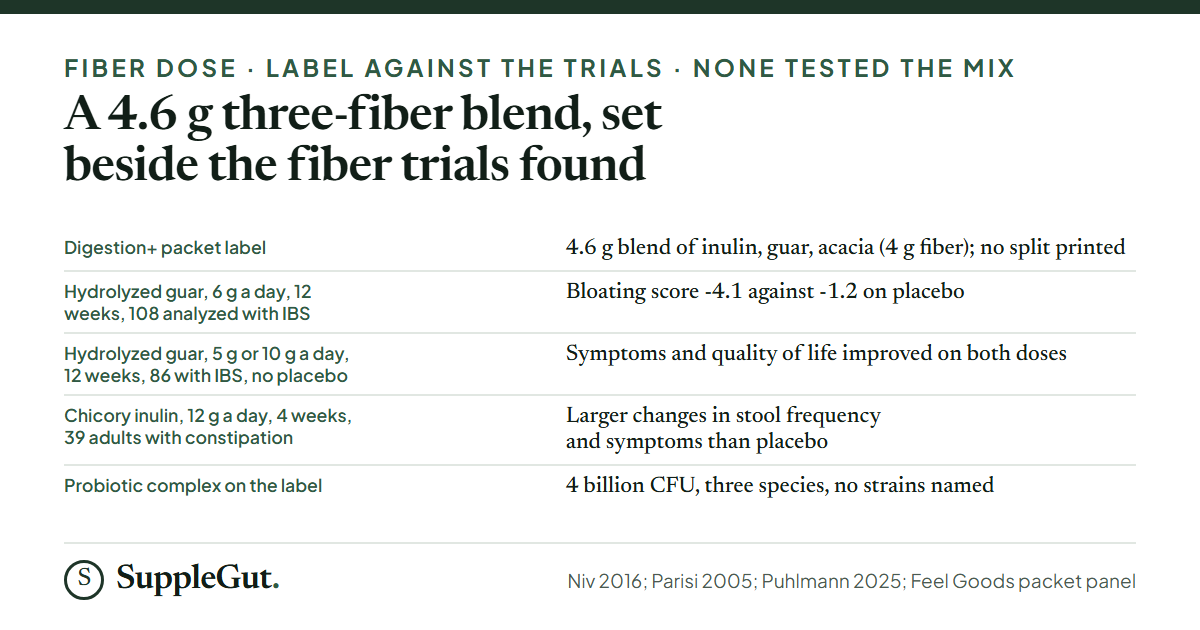
- Partially hydrolyzed guar gum in IBS. This is the largest trial found: a randomized, double-blind, placebo-controlled study of 6 g a day for 12 weeks. Of 121 people randomized, 108 were analyzed (49 on guar, 59 on placebo). A journal bloating score improved by 4.1 points against 1.2 on placebo (p = 0.03), and a bloating-plus-gas score by 4.3 against 1.12. Other journal symptoms and the severity and quality-of-life scores did not change. More people dropped out of the placebo group (49%) than the guar group (22%) (Niv et al., Nutrition & Metabolism, 2016).
- Hydrolyzed guar at two doses. An open randomized trial with no placebo compared 10 g (40 people) with 5 g (46 people) a day for 12 weeks in IBS. Symptoms and quality of life improved on both, and the improvement faded after treatment stopped (Parisi et al., Digestive Diseases and Sciences, 2005).
- Chicory inulin in constipation. In a randomized, double-blind, placebo-controlled crossover trial, 39 adults with functional constipation took 12 g a day for four weeks. Stool frequency, abdominal symptoms and quality-of-life scores changed more than on placebo. The authors report a carry-over effect between the two periods and ran the first period alone as a parallel check, which supported the result. Authors from the inulin’s supplier are listed (Puhlmann et al., BMC Gastroenterology, 2025).
Against these, the whole prebiotic complex in a packet is 4.6 g, split across inulin, guar and acacia in shares the label does not give. If the three fibers were divided evenly, each would be about 1.5 g, a fraction of the doses above, and the bloating trial was in people with IBS rather than a general population. Reaching a trial dose would mean working up through the suggested two to three servings a day, which the cost section prices.
The probiotic, the enzymes and the herb blend
The three probiotic species are common ones, but probiotic trials are run on named strains, and the label gives none. A search for the three species together in IBS trials returned mixed products tested at named strains, such as a synbiotic of named Lactobacillus and Bifidobacterium strains in IBS with diarrhea. Those results cannot be matched to a label that prints species only. How strain naming works is covered in the CFU guide.
For the 250 mg Bloat Complex and the 200 mg Enzyme Blend, the searches run returned unrelated records or reviews, and no trial of the finished combination was found. Ginger, lemon balm and apple cider vinegar share 250 mg between them, so the blend does not reach the amounts the page’s own dose-based claims would need. The herbs here are not laxative ones: the panel has no senna, cascara, aloe latex or rhubarb. The enzymes versus probiotics guide sets out what is known about each.
The “removes parasites” and metabolism claims
Two kinds of claim on the brand’s pages go beyond digestion. The first concerns parasites. The product page describes its fiber as a gentle way to flush out the gut that “removes parasites,” says the acacia “removes parasites, curbs your appetite, and helps you slim down,” and says it “keeps your gut free of parasites.” The second concerns metabolism: the page says the five enzymes speed it up. The brand gives no evidence for either, the panel lists no antimicrobial herb, and no trial of either claim was found. The brand’s FAQ also states that the product is not a laxative and is “not designed for explosive bowel movement.”
The page’s comparison table sets “Organic Soluble Fiber 4,000MG” for Digestion+ against “0MG” for “regular fiber,” with a Metamucil jar pictured. These are brand claims. The 4,000 mg matches the 4 g of dietary fiber on the packet panel. The Benefiber guide sets another common fiber powder beside its own label.
How to take it, and what two to three servings cost
The brand’s directions are to start with one serving a day and gradually increase to two or three as the body adjusts, mixing the powder into water and sipping it like iced tea, morning or evening. Whether to take it with food is not stated. For younger ages the brand says to use a half dose.
The headline price is for one serving a day, and the suggested dose changes it:
- A 30-serving tub is $49.99 one time, which is $1.67 a day at one serving.
- At two servings a day a tub lasts 15 days, about $3.33 a day. At three servings it lasts 10 days, about $5.00 a day.
- The 60- and 90-serving tubs are $89.99 and $127.49, or $1.50 and $1.42 a day at one serving. The 15-packet box is $31.99, $2.13 a day.
A reviewer with a one-star rating quotes the same arithmetic, writing that three scoops make a tub last about ten days.
Side effects and the early bloating the brand describes
Inulin, guar and acacia are fermentable fibers, which feed gut bacteria and can raise gas and bloating, mostly in the first days. The brand’s FAQ says so itself: “Temporary bloating is totally normal as your body adjusts to increased fiber intake.” Its answer is to begin at one serving and build up. Among reviewers, some report that it left them extremely bloated or with an upset stomach, and one reports an allergy to monk fruit extract.
The panel image and product page carry no warning text beyond the standard disclaimer that the statements have not been evaluated by the FDA. The brand says Digestion+ is designed for adults 18 and over and is generally safe during pregnancy, with a suggestion to speak with a physician first. No medication or condition warning was found. The probiotic or fiber guide covers where each type fits.
What buyers report
The brand’s product page runs an Okendo review widget that shows 4.7 out of 5 from 1,646 reviews: 1,363 five-star, 173 four-star, 68 three-star, 7 two-star and 35 one-star. The widget also rates taste at 4.6 of 5. The widget’s data flags 1,139 of the 1,646 reviews as incentivized. All of those are three, four or five stars (975 five, 125 four, 39 three), none at one or two. The 507 not flagged average 4.47. The flag is Okendo’s own field; the brand’s review-incentive program was not read, so what each reviewer received is not known. The ad landing page prints a typed header reading 4.8 from more than 2,000 reviews, which differs from the widget on the same page.
On Trustpilot the brand shows 3.4 from 21 reviews, with two-thirds at five stars and one-third at one star. No Amazon, Target or Walmart rating was found for the product.
Reviewers praise three things. Taste and mixability come first, with 759 of the 1,646 reviews mentioning taste or flavor. Less bloating is next: 355 reviews mention bloating, mostly as relief, and several describe feeling less bloated after weeks of daily use. Regularity follows, with reviewers writing about steadier bowel habits within days. The complaints are of three kinds: more bloating or an upset stomach in place of relief; a small container for the price once two to three servings a day are used, which includes a reviewer who measured a 6.9 oz tub against the 6.3 oz printed on the jar; and a changed taste after the packaging was redesigned. Others say they felt no effect.
Price, the default subscription and the billing record
The product page’s code starts in the subscription state, with “Subscribe & Save” listed above “Buy Once,” and the ad landing page says the plan “renews at $42.49 every 4 weeks by default,” with a billing reminder 3 days before the next order. The subscription takes 15% off the 30-serving tub, and can be set to 4, 6, 8 or 12 weeks. One-time purchase is possible. The new-customer offer on the ad page adds a starter kit, a free mixer and free shipping.
On refunds, the product page says: “All orders come with a 30-day money back guarantee, less a $9.99 fee for a prepaid shipping label and processing.” The refund policy page repeats the fee and also lists perishable goods and sale items as non-returnable, beside the 30-day guarantee; how the two apply to a powder is not stated.
Billing complaints repeat across both review platforms read. On Okendo, reviewers describe being signed up for a subscription automatically, being charged again after a single order, shipments without notice, and a returns fee they dislike. On Trustpilot, one reviewer reports being charged for two containers after a one-time trial, one an error at the last cancellation step, one a charge for a subscription she had forgotten, and one a package that never arrived. The Trustpilot page notes that the brand has not replied to most negative reviews. Of 43 Okendo reviews that mention subscription terms, most are positive, with comments such as keeping the subscription on.
Who Digestion+ is for
- Someone whose main complaint is bloating or irregular stools and who wants a flavored drink rather than an unflavored fiber, since the fibers here are in the same class as those in the trials.
- Someone comfortable starting at one serving and building up to the two or three the brand suggests, and pricing the tub on that basis.
- Someone who will read the subscription and refund terms before ordering, given the default plan and the $9.99 fee.
For other powders, the ProMix Debloat guide covers a prebiotic-probiotic mix, the Supergut guide a four-fiber blend with a 6 g scoop, and the Bloom Greens guide another drink-mix powder. Starting from the symptom, the bloating and gas guide and the quiz sort options by what bothers you most. Product pages: ProMix Debloat, Bloom Greens and Supergut.
The products in this catalog
Common questions
Is there proof that Digestion+ reduces bloating?
Not for the mix. A PubMed search under the product and brand names returned nothing. Hydrolyzed guar fiber at 6 g a day improved a bloating score in a trial of 108 people with IBS, but a packet here holds 4.6 g of three fibers with no per-fiber amounts, and it is not stated that the guar is hydrolyzed.
Is Gut Guardian the same product as Digestion+?
The brand’s older and internal name for the product is Gut Guardian, and reviews still use it. The product page is titled Digestion+, and the ad page that carried the Gut Guardian name returns a not-found page. A product called Clean Fiber does not exist on the brand’s store.
How much fiber does one packet of Digestion+ contain?
The packet panel (6.5 g) lists 4 g of dietary fiber, 14% of the daily value, inside a 4.6 g “Digestion Prebiotic Complex” of organic inulin, guar fiber and acacia. The grams for each fiber are not printed. The panel read is the 15-packet box; the 30-serving tub’s own panel could not be read.
Does Digestion+ remove parasites or speed up metabolism?
The brand’s page says the fiber “removes parasites” and that acacia curbs appetite and helps you slim down, and it describes the enzymes as speeding metabolism. The page cites no evidence for these, the panel lists no antimicrobial herb, and no trial of either claim was found.
What does it cost to take two or three servings a day?
A 30-serving tub is $49.99 one time, $1.67 a day at one serving. At the two to three servings the brand suggests after the first days, a tub lasts 10 to 15 days and costs about $3.33 to $5.00 a day. The subscription price is $42.49, about $1.42 a day at one serving.
How do the Feel Goods subscription and refund terms work?
The product page’s code starts on the subscription option, and one-time purchase is available. The brand’s ad page says the plan renews every 4 weeks by default with a billing reminder 3 days before. Its 30-day money-back guarantee is less a $9.99 fee for the return label and processing. Reviewers on Okendo and Trustpilot describe unexpected recurring charges and cancellation trouble.
Can Digestion+ cause more bloating at first?
The brand says temporary bloating is normal as the body adjusts to more fiber and suggests starting at one serving a day. Its fibers are fermentable, which can raise gas early on. Among reviewers, a few report constant bloating or an upset stomach, and one reports an allergy to monk fruit, a sweetener in the powder.
How much weight does the 4.7 rating carry?
It comes from the review widget on the brand’s own page. Okendo flags 1,139 of the 1,646 reviews as incentivized, all at three to five stars, and the 507 not flagged average 4.47. Trustpilot shows 3.4 from 21 reviews. No Amazon, Target or Walmart rating was found.
Sources
- Niv E, Halak A, Tiommny E, et al. “Randomized clinical study: Partially hydrolyzed guar gum (PHGG) versus placebo in the treatment of patients with irritable bowel syndrome.” Nutrition & Metabolism, 2016;13:10. PubMed 26855665
- Parisi GC, Bottona E, Carrara M, et al. “Treatment effects of partially hydrolyzed guar gum on symptoms and quality of life of patients with irritable bowel syndrome. A multicenter randomized open trial.” Digestive Diseases and Sciences, 2005;50(6):1107–1112. PubMed 15986863
- Puhlmann ML, Wegh CAM, van der Zalm SCC, et al. “Inulin-induced improvements on bowel habit and gut microbiota in adults with functional constipation: findings of a randomized, double-blind, placebo-controlled study.” BMC Gastroenterology, 2025;25(1):806. PubMed 41233756
- Feel Goods Digestion+: product page, FAQ, packet panel image, tub photo, price and subscription data. feelgoods.co
- Feel Goods Digestion+ ad landing page: subscription terms, new-customer offer, third-party testing statement and typed review header. feelgoods.co
- Feel Goods refund policy. feelgoods.co
- Okendo review widget and public aggregate for the Digestion+ product page: rating, star counts and incentivized flag. feelgoods.co
- Trustpilot profile for feelgoods.co. trustpilot.com
Still deciding between products?
The guide gives the background. For a single answer, the quiz asks about your symptoms, your routine and what you have tried, then names one product.
Take the quiz →